Four mass shootings in three weeks leave Minneapolis on edge as leaders search for solutions

In the span of 12 hours Monday, 12 people were shot in two separate locations in Minneapolis. The city was already reeling from weeks of violence.

September 17, 2025 at 1:34AM
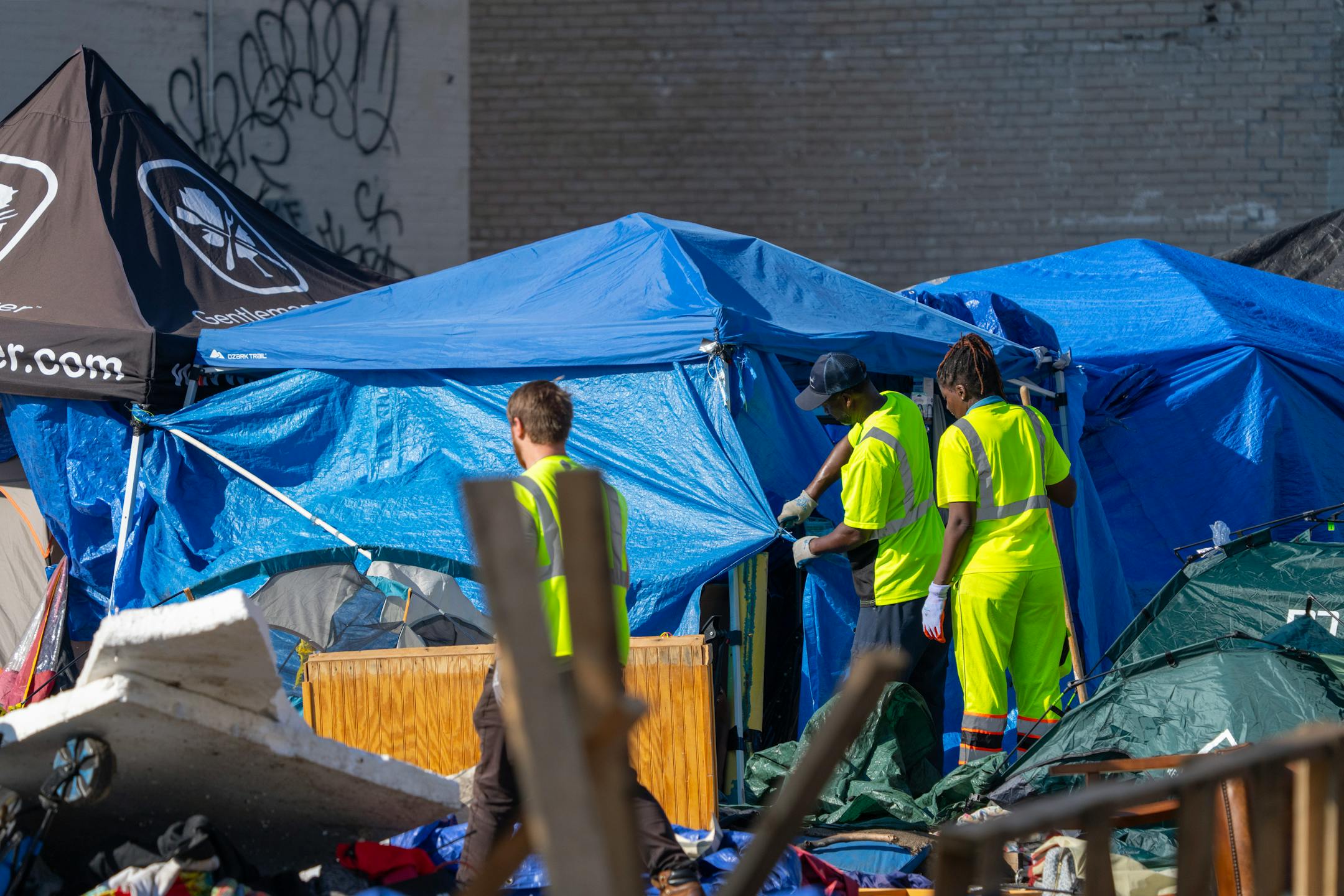
Workers from the city of Minneapolis clear a homeless encampment near E. Lake Street and S. 28th Avenue in Minneapolis on Tuesday after a shooting took place there the night before. (Alex Kormann/The Minnesota Star Tribune)

In the span of 12 hours Monday, from midmorning to near midnight, Minneapolis Police Chief Brian O’Hara trudged to city scenes covered in blood and bullet casings.

Just 2 miles apart on Lake Street — an area long the vibrant immigrant-dense commercial corridor of Minneapolis — 12 people were shot in spaces where the homeless, drug-addicted and destitute congregate.

One of the shootings took place near the Interstate 35 exit ramp where drug dealing and drug use are carried out in broad daylight. The other shooting took place at an unauthorized homeless encampment on the property of Hamoudi Sabri, a prominent Minneapolis landlord who has defied city officials and refused to shut it down.

“This is not normal,” O’Hara said of the violence.

Recent evidence seems to contradict him.

Over the weekend, three additional shootings in the city left two dead and two injured. Three weeks ago, just blocks away from Monday’s shooting near I-35, one man was killed and six others were injured in a midday shooting near Cristo Rey Jesuit High School where about 30 rounds were fired from a high-velocity .223-caliber gun. One day later, a shooter fired into Annunciation Catholic Church during a back-to-school Mass, killing two children and injuring 21 others. The shooter died by suicide.

Tidy blue and green ribbons honoring those victims remain wrapped around trees and light poles in wide swaths of the south side, physical remainders of the recent bloodshed in the city.

City leaders have tried to bolster the city’s image after the pandemic and unrest that followed George Floyd’s murder by touting improvements in crime statistics, community safety and redevelopment. But this month’s gun violence, a grim coda to the summer, has left them and residents alike unsettled.
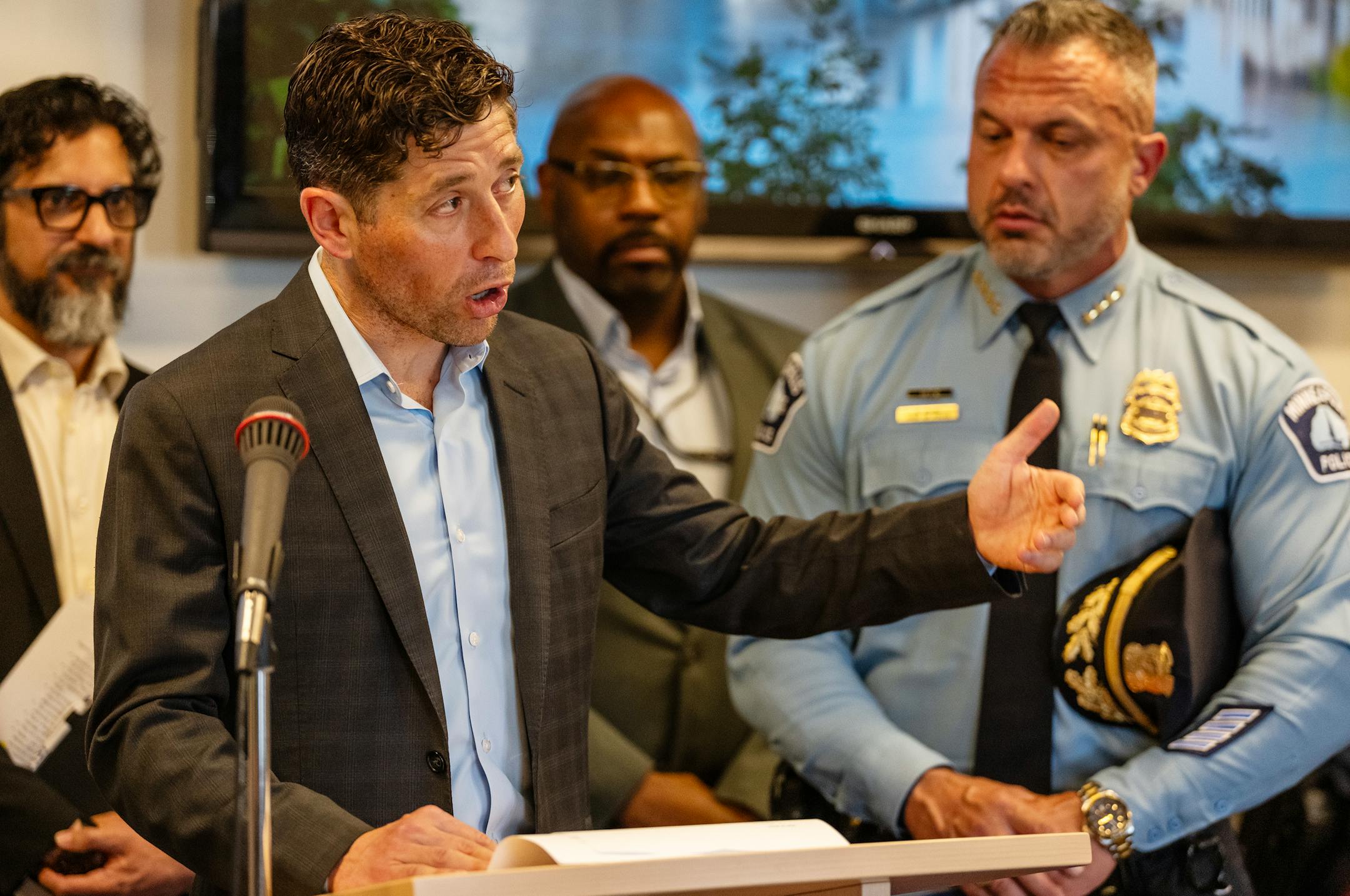
After the shooting Monday night, nearly 20 squad cars were dispatched to the scene, and an exasperated Mayor Jacob Frey stood at a news conference and said the community deserved better.

"These homeless encampments are not safe either for the people that are in them, nor are they safe for the surrounding neighborhood," Mayor Jacob Frey said at a news conference Tuesday. (Richard Tsong-Taatarii/The Minnesota Star Tribune)

“This is tragic, it is horrible, it is unacceptable and sadly it is not surprising,” Frey said.

As midnight drew near, a rotating cast of onlookers approached the crime scene as forensic analysts combed the street with flashlights for shell casings.

“Didn’t we already do this today?” Steve Christen, a nearby resident, asked no one in particular.

Christen said he was sitting outside when he heard a barrage of about 20 shots pierce the night air. Seconds later, another volley erupted — even closer to his Longfellow neighborhood home. Christen rushed inside, instructing his family to hide until the bullets stopped. After police swarmed the area, they trekked down the street to assess the scene.

His 10-year-old son watched as dozens of red and blue police lights ricocheted off graffiti-covered buildings.

“He ain’t going to sleep anytime soon,” Christen said.

In response to the shooting, the city requested assistance from State Patrol troopers and Hennepin County Sheriff’s Office deputies. There will be additional troopers starting Wednesday, and Metro Transit police will have a greater presence along Lake Street.

It also led Frey to order the city to fence off the area near I-35 where drug use had proliferated and close the homeless encampment 2 miles down the road on Sabri’s property.

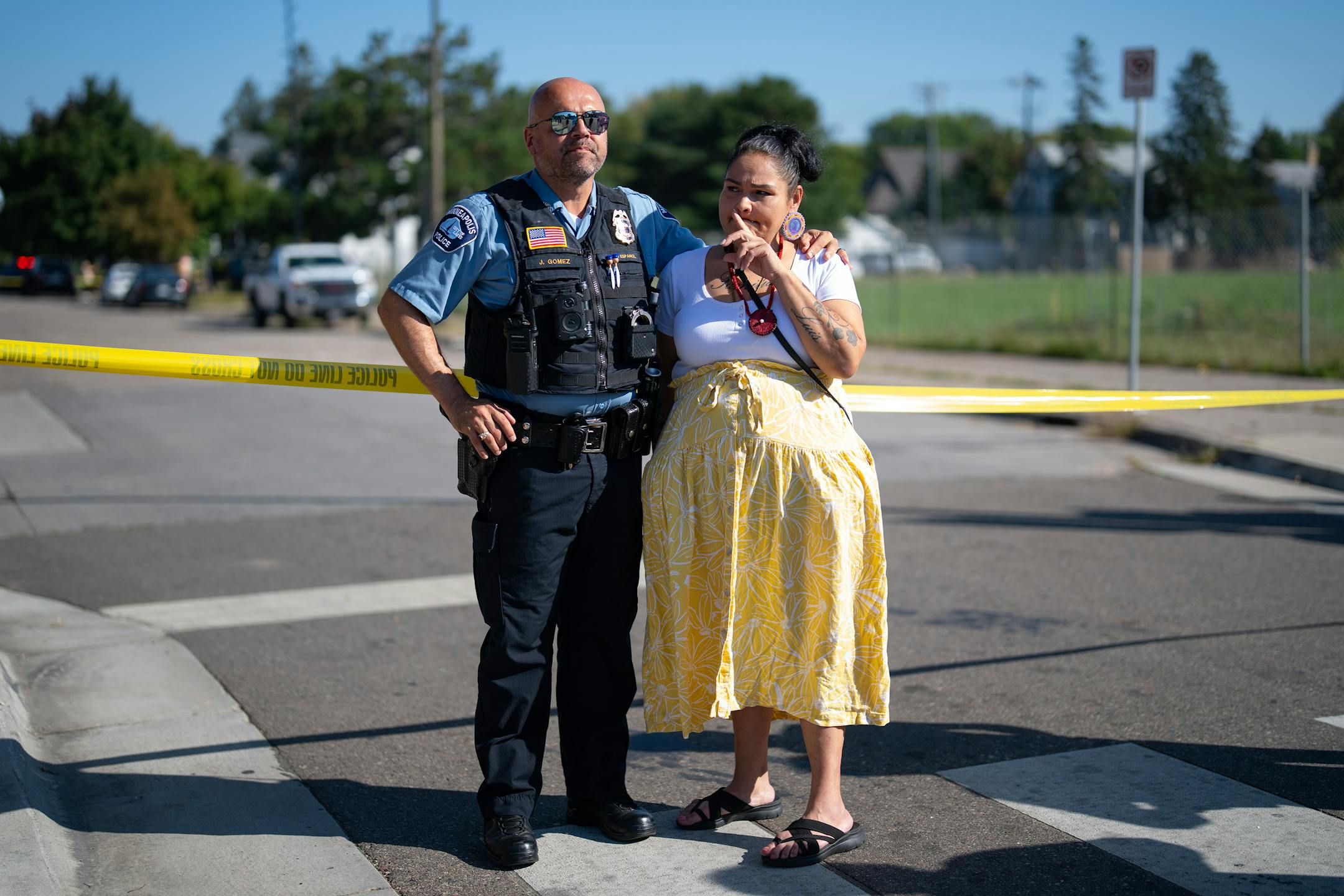
Minneapolis Police Inspector Jose Gomez watches with Nicole Mason, a former organizer of a homeless camp dubbed Camp Nenokassi, as another homeless encampment is cleared near E. Lake Street and S. 28th Avenue in Minneapolis on Tuesday. (Alex Kormann/The Minnesota Star Tribune)

‘Here we are, yet again’

In seven weeks, Minneapolis residents will choose whether to re-elect Frey to a third term. Every seat on the city council is also on the ballot.

Before these shocking acts of violence, a Star Tribune analysis of police data showed violent crime in Minneapolis trending downward: 45 murders to date, down from 55 last year. The number of shooting victims dropped to 226 from 277 last year, driven largely by less gun violence on the North Side. While these counts still represent stark reductions in violence from the city’s pandemic-era highs, both measures surpass 2019’s numbers for murders (30) and shootings (200) and have respectively surged about 13% and 57% over the past 28 days.

The last three weeks have been especially traumatic because Minneapolis residents experienced four mass shootings. Before that, there had been four mass shootings all year, according to the Gun Violence Archive. While no standard definition of a mass shooting exists, the Gun Violence Archive defines them as an event with four or more victims shot, not including the perpetrator.

Standing in front of police tape and tents Monday night, O’Hara shook his head as he began to speak to the media.

“Here we are, yet again,” he said, “in the aftermath of a mass shooting.”

It had been a particularly violent 48-hour stretch in Minneapolis, where gunfire killed two and wounded at least 15 others throughout the city.

Seven people were injured in the encampment shooting Monday night, including a man and a woman gravely wounded in their respective tents from shots to the head. Another man was struck in the stomach. Others went on their own to area hospitals, including one man with gunshot wounds to the neck and torso.

“People need to know we are not going to quit,” O’Hara said of his police force. “We’re going to continue to do everything that we possibly can to hold these folks accountable.”

So far, no one has been arrested in connection with the shootings Monday or the shooting outside Cristo Rey Jesuit in late August.

The first shooting Monday occurred just after 11 a.m. Five people were shot and injured on Stevens Avenue near the Midtown Greenway and Lake Street transit station. One victim was rushed to HCMC with serious injuries after he was struck in the head and neck area, police said. Three others were hospitalized with noncritical injuries, and one victim who had been grazed declined medical treatment.

Homeless encampments have occasionally cropped up in the area, with at least three shootings occurring nearby over the last month.

O’Hara said he “still cannot entirely rule out” that the two mass shootings were connected, but investigators believe there was more than one gunman in both cases. The second shooting at the encampment is believed to stem from a narcotics dispute. The first shooting appeared to be a “separate quarrel that escalated to gunfire.”

Jeff Hargarten of the Minnesota Star Tribune contributed to this story.

about the writers

about the writers

Jeff Day

Reporter

Jeff Day is a Hennepin County courts reporter. He previously worked as a sports reporter and editor.

See Moreicon

Liz Sawyer

Reporter

Liz Sawyer  covers Minneapolis crime and policing at the Star Tribune. Since joining the newspaper in 2014, she has reported extensively on Minnesota law enforcement, state prisons and the youth justice system. 

See Moreicon

Louis Krauss

Reporter

Louis Krauss is a general assignment reporter for the Star Tribune.

See Moreicon

More from Minneapolis

See More
card image
Jose Luis Magana/The Associated Press

U.S. attorney general says alleged serial rapist struck because Minnesota is ‘soft on crime’

card image