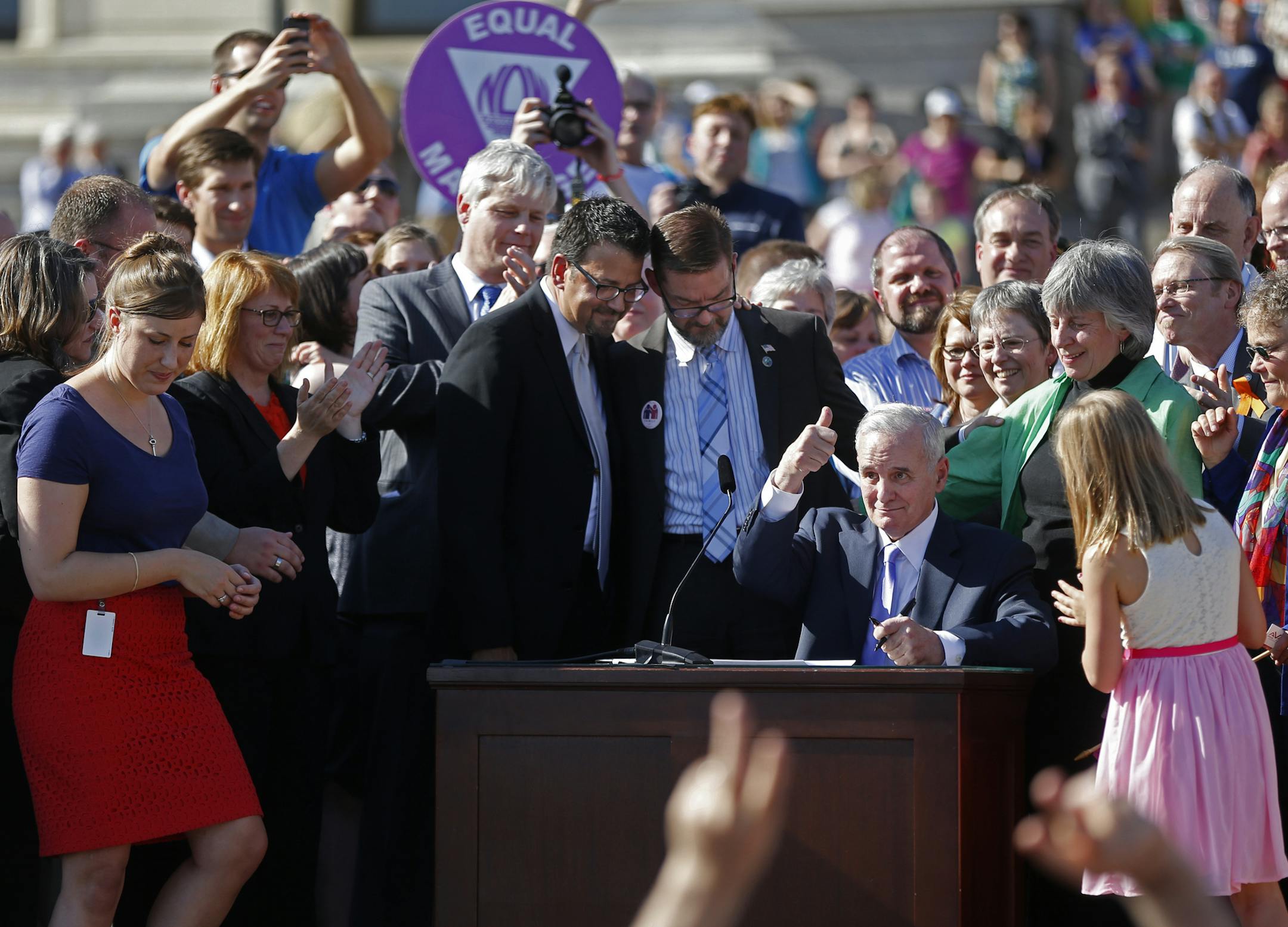
While the passage of legislation to legalize same-sex marriage in Minnesota has advocates celebrating, the future walk down the aisle won't be completely covered in rose petals when it comes to equality in company-sponsored benefits.
In fact, differences in the way the federal government and the state define marriage has several implications for businesses as they determine how the Minnesota statute will affect their benefit programs.
With the new law taking effect Aug. 1, and a ruling expected this summer by the U.S. Supreme Court on the Defense of Marriage Act (DOMA), a lot is still undecided. In the meantime, here are a few guidelines that can help employers as they evaluate the change to Minnesota law.
Consider state and federal laws when determining benefit policies. Minnesota is the 12th state to legalize same-sex marriage. While some states are making it easier for couples to recognize the unions, there are still hurdles at the federal level when it comes to employee benefits because the U.S. government defines marriage as a union between two individuals of the opposite gender.
The U.S. Supreme Court is currently debating a case relating to DOMA, which denies married same-sex couples a range of benefits that are available to heterosexual couples.
When determining benefits policies in Minnesota, companies first and foremost need to follow all federal laws that have no state equivalent. For example, employee benefit plans covered by ERISA (Employment Retirement Income Security Act) do not change. Benefits that remain federally mandated include Social Security benefits, pension plan benefits, spousal immigration rights and income tax benefits.
In the case where a law has both a state and federal statute on the same topic, or only a state law, protections will now extend to the same-sex spouse. For instance, employers required to provide 12 weeks of unpaid leave for an employee with a serious medical condition, or to care for a spouse or close family member under FMLA (Family Medical Leave Act), need to extend those protections. Minnesota has state FMLA provisions and employers are required to provide those benefits to the same-sex spouse.
When evaluating any benefit policy, employers should consider whether they operate in a state that recognizes same-sex marriage. Employees living in states recognizing same-sex unions should have those state law benefits extended to them.