

Right now, many birds are feverishly pushing together cups of mud and grass, twining twigs into basket shapes or scraping together circles of soil and pebbles as nesting season gets underway. Their labors produce strong, resilient, sometimes even beautiful structures.
But the nests aren't what's important. What's important is the eggs that will be deposited in them.
Almost as soon as the nests are complete, the female will begin laying eggs. She'll lay a single, hard-shelled egg every day or every other day until her brood is complete. For a mallard hen, that's usually 12 eggs. For a house wren, that's six eggs. Goldfinches usually lay five eggs, while eagles tend to lay two big eggs.
The eggs themselves -- from a hummingbird's jellybean-sized eggs to the grapefruit-sized eggs of an ostrich -- are engineering marvels. They're a perfect life-support system, keeping the developing bird safe and well fed during incubation. Encased in calcium carbonate, the developing embryo feasts on yolk and albumin and breathes air trapped inside its shell. And the thin but strong shell is designed to be easier for the chick to break out of than for a predator to break into.
Colorful, changeable eggs
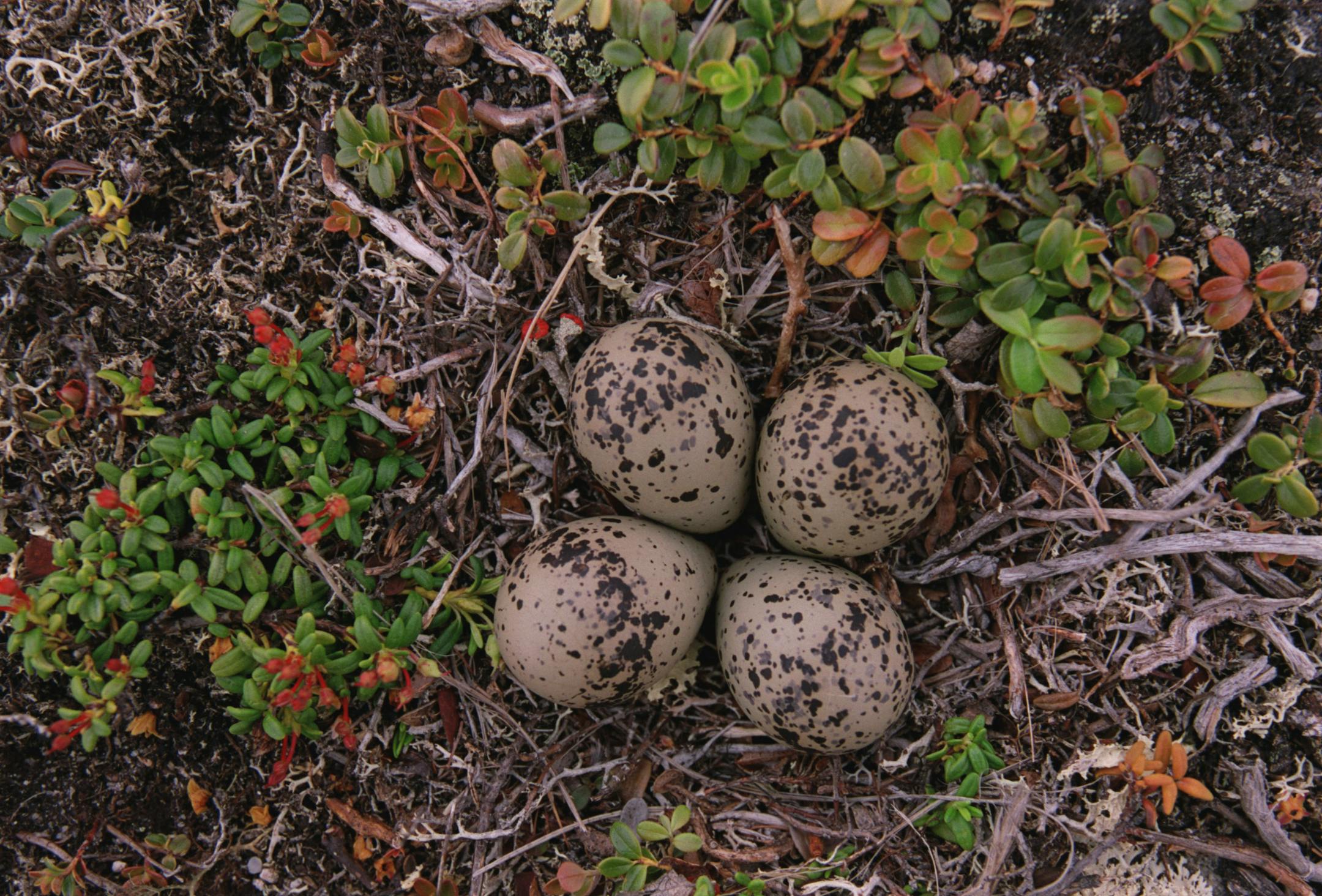
We often think of eggs as white, but only about one-fourth of eggs are white. Most come in a surprising variety of colors: vivid blues and greens, pinks and oranges, even dark browns and charcoals. Eggshells can be speckled, blotched, streaked, lined or flecked with color. And, in some birds, notably grebes, white eggs gradually become camouflaged as they pick up color from the nesting materials.
The shapes of eggs also vary from round to oval to cylindrical to fit the nest style. Oval eggs won't roll easily off a ledge, for example. Birds that nest in cavities -- such as nuthatches, tree swallows and screech owls -- can afford to lay rounder eggs, because the tree hollow or nest box protects them.
Lullabies and chirps


