

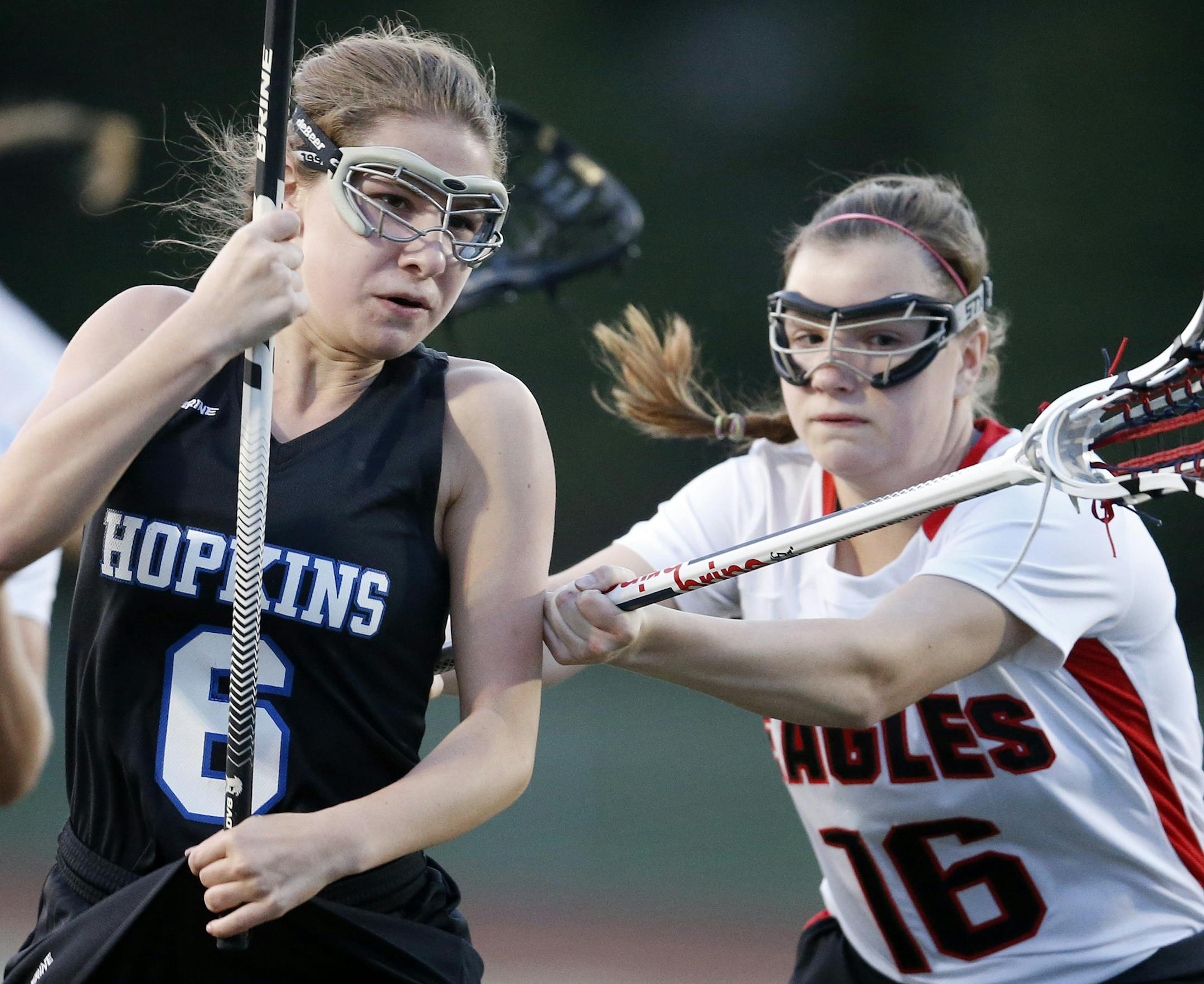
Delighted by the rapid growth in high school girls' lacrosse, national officials and local coaches are much less psyched about altering their game amid questions about its safety.
Florida recently became the first state to mandate that high school girls' lacrosse players don soft protective headgear, a response to concussion and traumatic injury concerns in a sport in which players carry sticks and launch hard balls.
Girls' lacrosse has the fifth-highest rate of concussions among all high school sports, national figures show. Football leads the way, followed by boys' hockey, boys' lacrosse and girls' soccer.
Coaches in Minnesota, while acknowledging issues with rough and dangerous play, are wary of becoming a headgear state. That view is shared nationally by US Lacrosse, the sport's national governing body.
Ann Kitt Carpenetti, the national group's vice president of lacrosse operations, said additional protective gear will have an opposite effect, where the need for less care equals more contact and the sport loses its essential elements of skill and speed. Hard helmets, shoulder pads, elbow pads and gloves are required for playing the more physical boys' game. Female players wear only eye protection. Goalies in both sports always have worn helmets.
"I'm not saying there's no way any additional protection can increase safety," Kitt Carpenetti said. "But I still don't feel that's the silver bullet."
Stillwater coach Rick Reidt said he believes that rather than adding equipment, coaches "need to take responsibility and teach correct technique and the officials need to officiate to the rule book" to ensure a safer game.
Nationally, lacrosse ranks as the fastest-growing sport at the high-school level, with 290,046 players competing in 2013. From 2008 to 2013, 621 schools added boys' teams and 588 added girls' teams, according to data from the National Federation of State High School Associations. Minnesota recently expanded its state tournament to eight teams in recognition of similar growth.
![Naomi Rogge (2) and Eden Prairie Lacrosse teammates huddled up before a game against Hopkins. ] CARLOS GONZALEZ cgonzalez@startribune.com, April 16, 2015, Eden Prairie, MN, Girls lacrosse game. Hopkins at Eden Prairie High School, Prep](https://arc.stimg.co/startribunemedia/OHODCFVX5NP2FEYETCLZYG3SPQ.jpg?&w=1080)


