

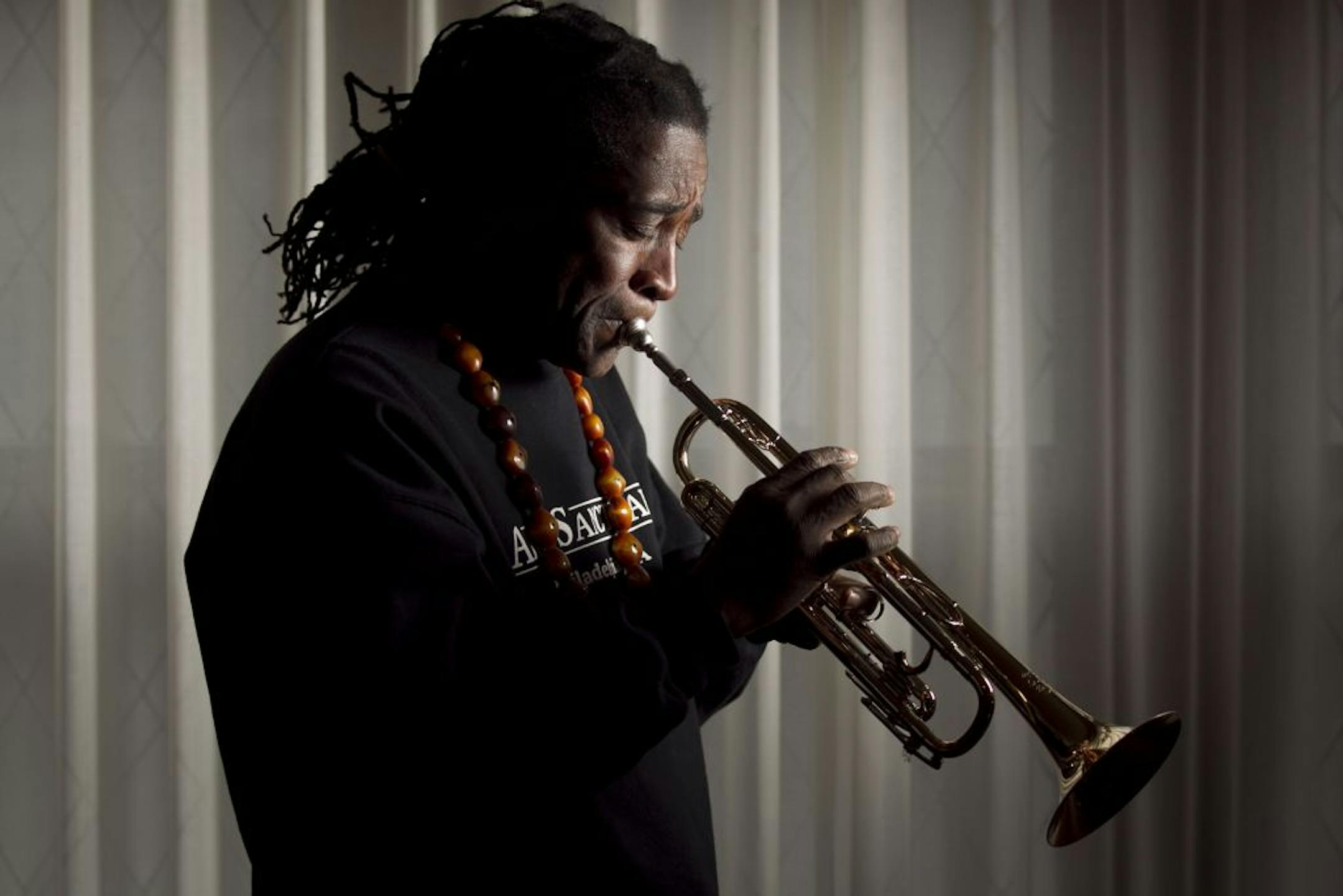
Over the past four decades, composer, trumpeter and humanitarian Hannibal Lokumbe has used his colorful life as both teaching text and testimony. Even as he has played and recorded with such jazz legends as Gil Evans, Pharoah Sanders and Elvin Jones, Lokumbe, 63, has kept his feet anchored in community. At the height of his jazz career he quit playing in clubs in order to focus on working with at-risk young people.
During his recent spell in the Twin Cities for the premiere of a composition about his spiritual journey, Lokumbe spoke at Ujamaa Place, a St. Paul center dedicated to transforming the lives of disadvantaged young black men. He encouraged program participants to research their own family trees and to connect with their ancestors.
When we know our history, we know ourselves, Lokumbe said.
Lokumbe's community work melds with his composition "In the Spirit of Being," a VocalEssence commission that will be premiered Sunday at St. Paul's Ordway Center. Lokumbe will play trumpet in a concert that also features vocal soloist Tonia Hughes, pianist Sanford Moore, the Ramsey School Performing Arts Magnet Children's Choir, the Macalester College African Music Ensemble and the VocalEssence Chorus conducted by Philip Brunelle.
We recently talked with Lokumbe about his work.
I was born in Smithville, Texas [just east of Austin] and spent the first five years of my life on my grandmother's farm. I didn't wear shoes until I was 6.
As a child, my best friend wasn't a computer. It was the sky and the Colorado River, which was behind us. The ground of my family's farm told me that I was sacred. So when I encountered society and all of the labels it wanted to put on a little black boy, I had something solid to look back on.
Music began to be important to me very early on, maybe when I was 4 or 5. I was working in the cotton fields when I first noticed my mother singing. My grandfather and grandmother sang also, and they sang for survival, not for pleasure. You see, to pick cotton, which is what we did, we would always go into the fields before sunup. By the time it hit 1 o'clock, it would be unbearably hot. When that happened, my grandparents and everybody would have these waves of heat coming off their bodies. They just looked like apparitions. Without fail, once it got that hot, they began to sing. They sang to cool themselves. Their songs were more like prayers. Many times when I play the trumpet now, I hear things from those experiences, and that's what I play.


