
How the Minnesota Orchestra plays to a younger audience on social media

While some institutions have been slow to embrace social media like Instagram and TikTok, the Minnesota Orchestra has invested in it, more than doubling its audience.

The Minnesota Star Tribune
November 6, 2025 at 2:00PM
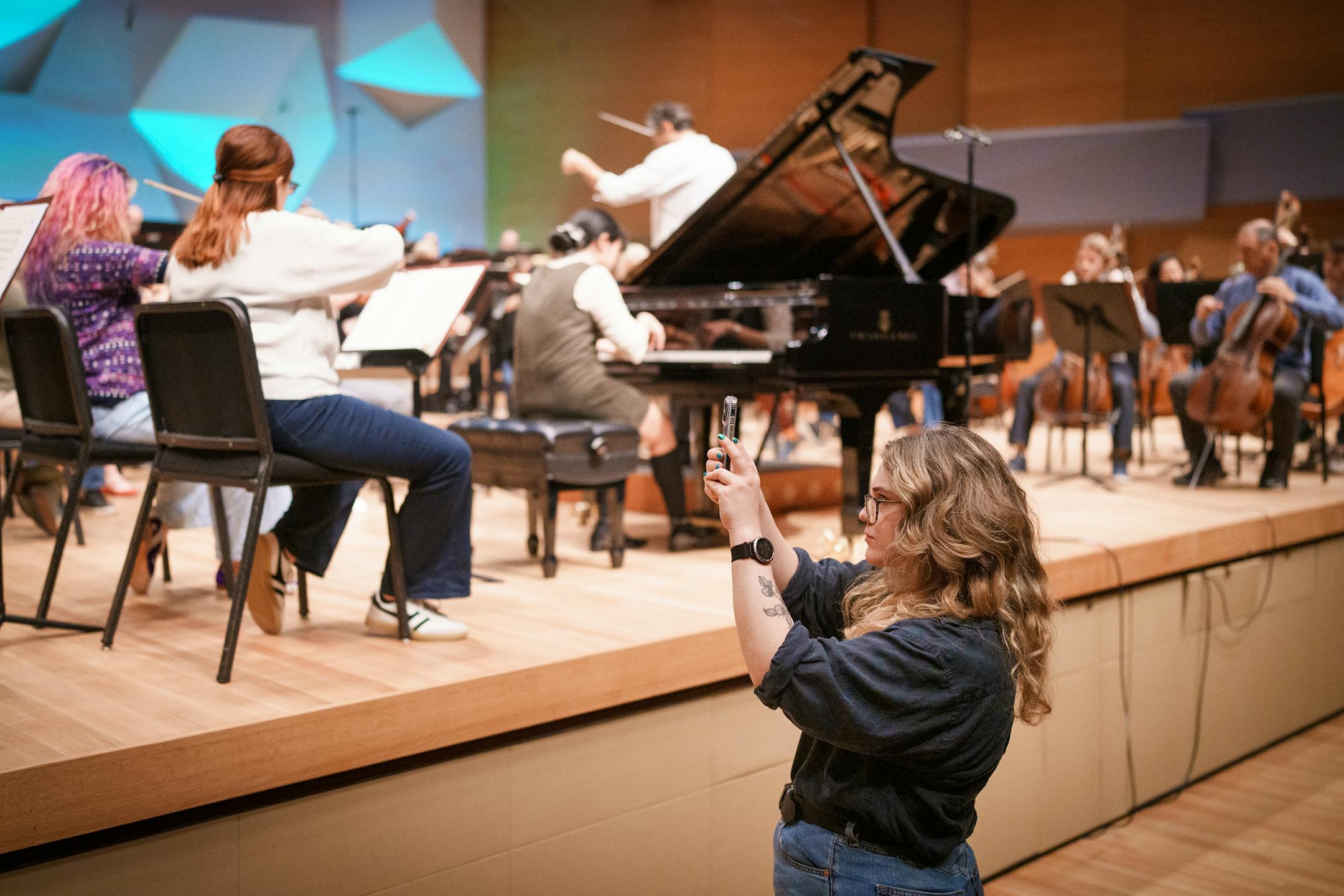
Alexandra Robinson, social media manager at the Minnesota Orchestra, records video during a rehearsal at Orchestra Hall. (Leila Navidi/The Minnesota Star Tribune)

The day before a fall show, Minnesota Orchestra musicians rushed through the stage door for rehearsal. At the bottom of the stairs was the orchestra’s social media manager with an iPhone carefully balanced atop a tripod to record their most anxiety-inducing performance stories.

“Let me fix my hair,” said oboist Marni J. Hougham, who quickly returned to tell her story of stage lights going out mid-performance at Carnegie Hall.

Minnesota Orchestra musicians play in front of large audiences, but with the help of social media, they are reaching younger crowds online than who have traditionally been drawn to classical music. The candid posts have also deepened engagement with orchestra diehards.

Social media manager Alexandra Robinson has grown the @minnorch Instagram account from 18,000 to nearly 50,000 followers over the last few years. She also launched the orchestra’s TikTok account back when the app was skyrocketing in popularity.

While some fine arts institutions have historically written off social media as unimportant, the Minnesota Orchestra has chosen to invest in it, becoming one of the first symphony orchestras in the country to hire a dedicated social media content creator.

Minnesota orchestra members have grown accustomed to taking a moment during their breaks, often with instruments in hand, for quick cameos in Robinson’s social media videos. The short clips aim to make the distinguished classical instrumentalists more relatable.

“These are funny people,” Robinson said. “They’re having fun together. They really like each other. This is a place where I can be human.”
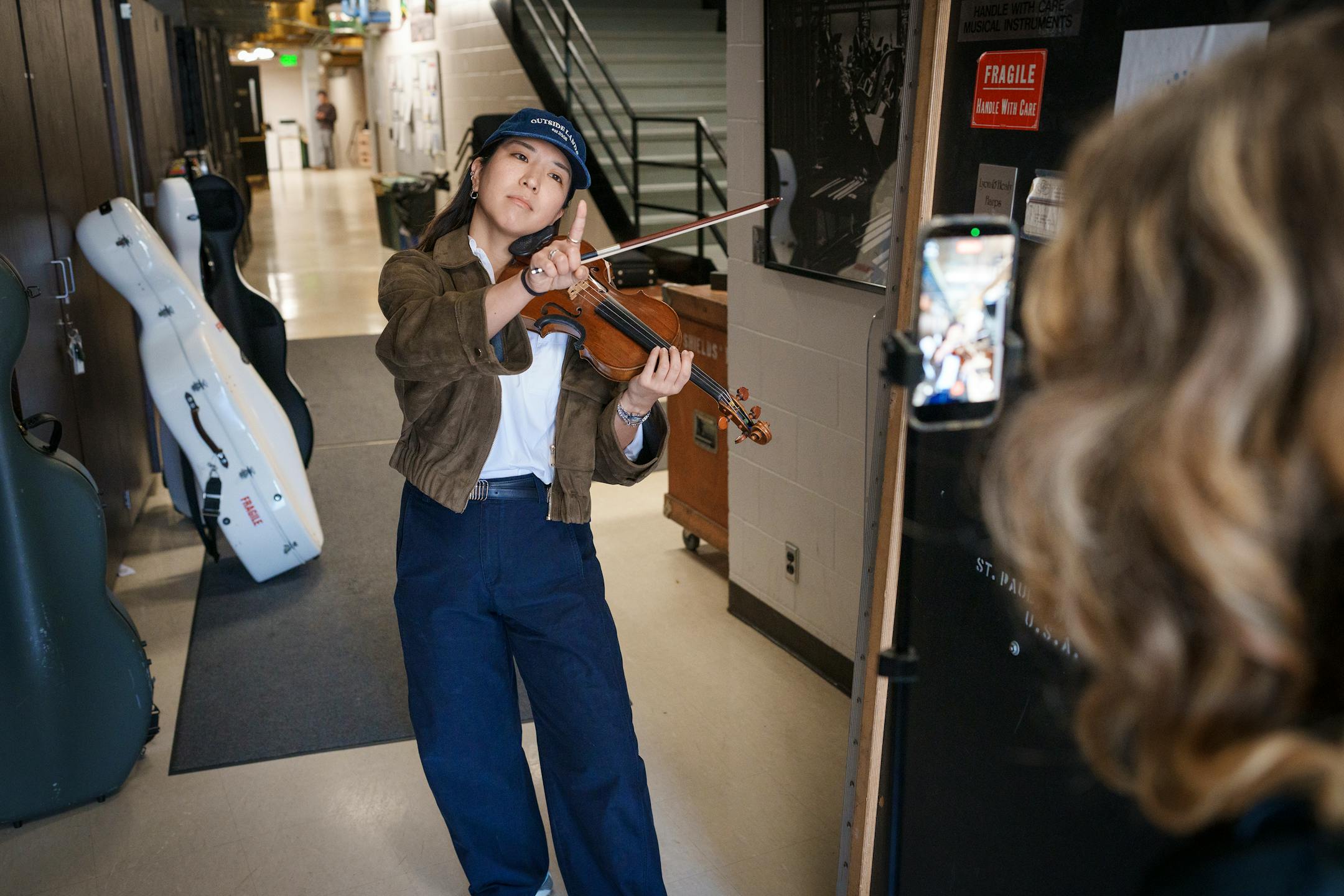
Violin player Natsuki Kumagai plays her violin with a “baby bow” as Alexandra Robinson, social media manager at the Minnesota Orchestra, records video for social media content. (Leila Navidi/The Minnesota Star Tribune)

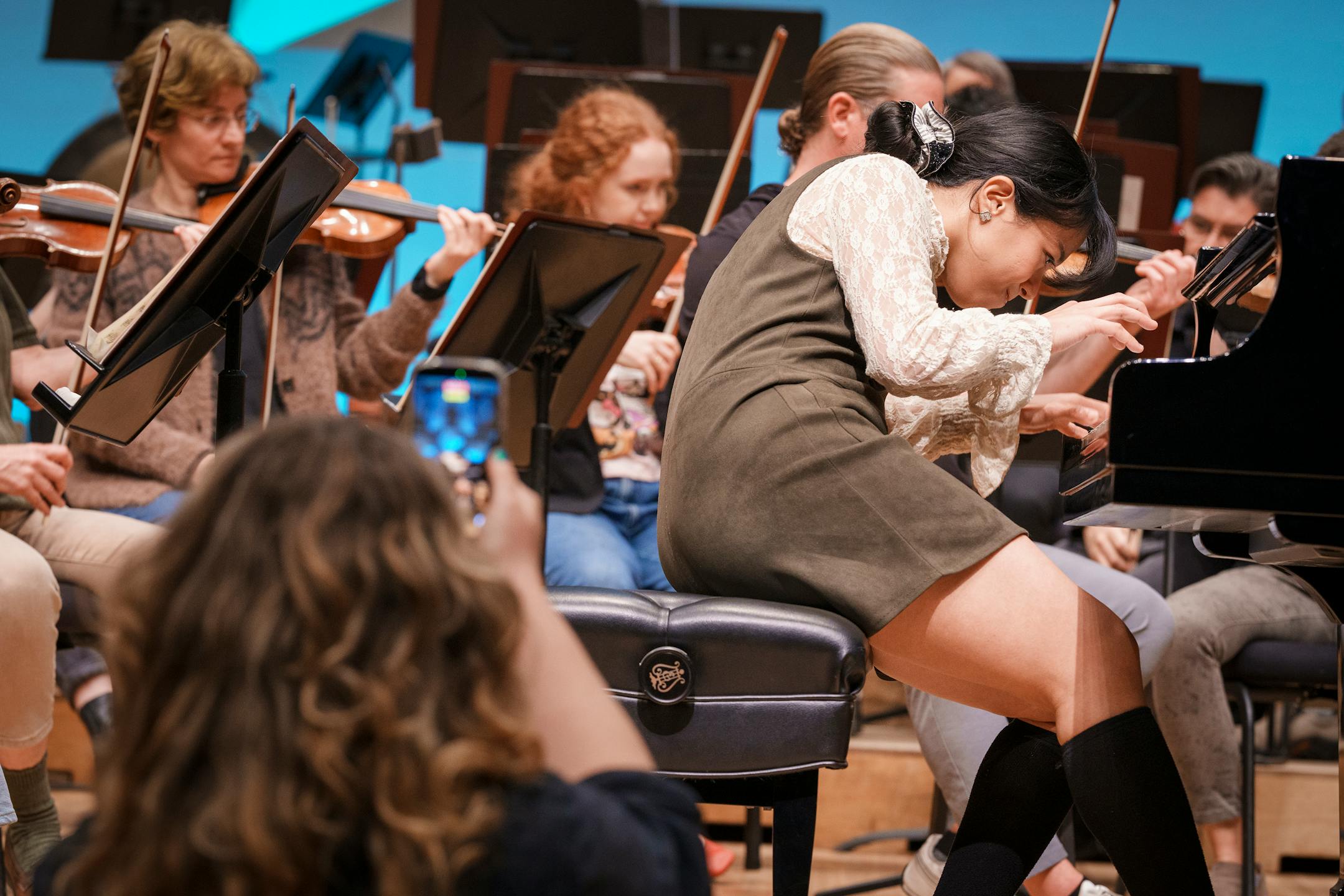
Between capturing scary performance stories during rehearsal last week, Robinson recorded a promo video with visiting piano soloist Janice Carissa and a clip with first violinist Natsuki Kumagai playing with a tiny children’s bow.
The tiny bow video was inspired by Kumagai’s Instagram account, where she made a video directed at students who say their bows are too small to play properly.

Content like that can help make the orchestra, which might be traditionally thought of as stuffy, feel more approachable, said Robinson, who mentioned friends from outside of orchestra culture have said they felt nervous about being too loud or wearing the wrong thing when attending a performance.

Second violinist Michael Sutton said orchestra members have become more accustomed to being part of social posts as more digital natives have joined the orchestra, he said.

“If you look at the average age here, it’s getting younger. When I got here 28 years ago, I was a child; now I’m the old guy,” Sutton said. “The people here grew up with social media.”

According to the League of American Orchestras, there has been a notable increase in the percentage of tickets bought by younger patrons, with the proportion of tickets bought by millennial buyers surging from 9% in 2019 to 25% in 2023.

Classical music is still the backbone of film scores. It’s not uncommon to hear a classical tune pack a comedic punch to a viral meme on TikTok. Classical music has also found converts who turn to it for relaxation and focus.

But classical music popularity doesn’t mean that young people are filling orchestra halls, said Alex Legeros, the director of Franconia Sculpture Park in Shafer, Minn., who has played the bassoon and contrabassoon with a variety of local bands and orchestras. Legeros has researched why legacy institutions have struggled to attract younger people and said he thinks orchestras can do more to truly engage with millennials, Generation Z and younger.

“Six out of 10 millennials still listen to classical music on streaming, even though two to three out of 10 might actually go to a concert,” Legeros said. “So it’s not like we’ve lost classical music or an appreciation for classical music.”

In the mid-20th century, a large portion of orchestral audience members were under 30, according to Legeros. Past community engagement efforts, such as a requirement by the Minneapolis Symphony Orchestra (now the Minnesota Orchestra) that performers teach young people, helped cultivate youth interest in the orchestra. Today, those same young music lovers have grown older.

“Classical music institutions have a duty to cultivate that next generation of audiences,” Legeros said. “It starts in the schools. You can’t wait until people are 20 or 30.”

Alexandra Robinson, social media manager at the Minnesota Orchestra, records video for social media content as Janice Carissa plays a solo on piano during rehearsal with the Orchestra at Orchestra Hall. (Leila Navidi/The Minnesota Star Tribune)

The Minnesota Orchestra’s intentional work to appeal to a diversity of music lovers has had results. Millennials and Gen Xers account for 63% of the orchestra’s single-ticket sales, which tracks younger than Minnesota’s orchestral peers across the country, Robinson said.

In general, pop concerts or movie concerts, like the October performances of “The Goonies,” where the entire score was played live to the film, tend to especially attract younger audiences.

The orchestra has also tried to appeal to younger people with discounts. For the last decade, the Minnesota Orchestra has offered a deal allowing attendees under the age of 40 to purchase $20 tickets to select concerts. For college students, $15 rush tickets are available for some concerts with a valid student ID.

Still, young people aren’t the only ones embracing the Minnesota Orchestra’s clever social posts. While the culture of the internet right now is being driven by Gen Z, that doesn’t mean it’s exclusively for Gen Z, she said. Her goal is to meet people where they are on these platforms no matter their age.

“Of course we want younger audience-goers, we want to attract new audiences,” Robinson said. “But I also think there’s a lot that organic social can do to reawaken and deepen love for people that are already here and already invested.”

Minnesota Star Tribune intern Tyler Church contributed to this story.

about the writer

about the writer

Zoë Jackson

Reporter

Zoë Jackson is a general assignment reporter for the Star Tribune. She previously covered race and equity, St. Paul neighborhoods and young voters on the politics team.

See Moreicon

More from Music

See More
Lissie
The Minnesota Star Tribune

Highlights from Dec. 25-Jan. 7 include Soul Asylum, the Bad Plus, the New Standards, Cats Under the Stars, Nur-D, Lissie, Karl Denson and a Replacements tribute.

card image