

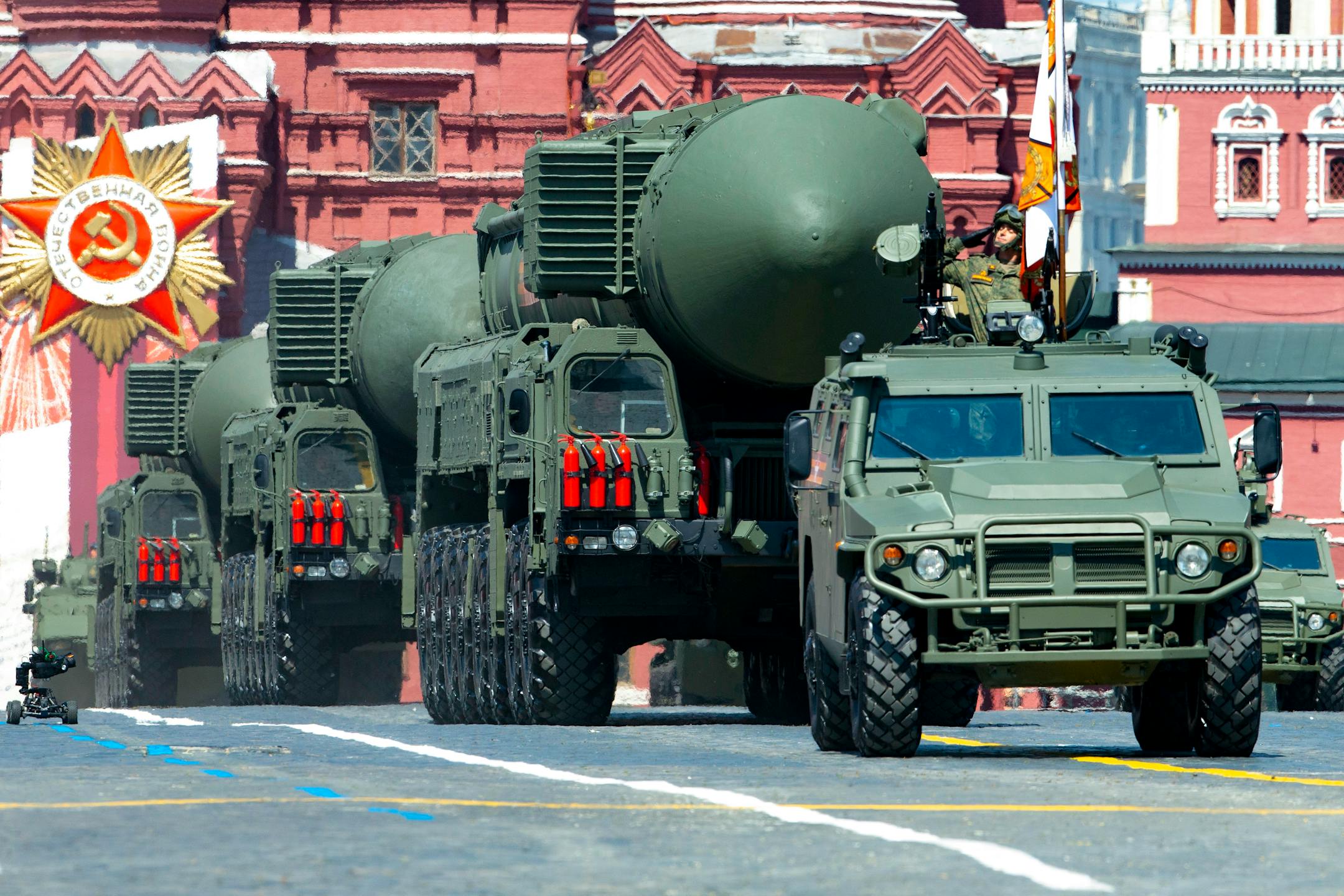
WASHINGTON – For the first time since the Cuban missile crisis in October 1962, top government leaders in Moscow are making explicit nuclear threats and officials in Washington are gaming out scenarios should President Vladimir Putin decide to use a tactical nuclear weapon to make up for the failings of Russian troops in Ukraine.
In a speech Friday, Putin raised the prospect anew, calling the United States and NATO enemies seeking Russia's collapse and declaring again that he would use "all available means" to defend Russian territory — which he has now declared includes four provinces of eastern Ukraine.
Putin reminded the world of President Harry S. Truman's decision to drop atomic weapons on Hiroshima and Nagasaki, Japan, 77 years ago, adding, "By the way, they created a precedent." On Saturday, the strongman leader of the southern Russian republic of Chechnya, Ramzan Kadyrov, said Putin should consider using "low-yield nuclear weapons" in Ukraine, becoming the first prominent Russian official to openly call for such a strike.
Senior U.S. officials say they think the chances that Putin would employ a nuclear weapon remain low. They say they have seen no evidence that he is moving any of his nuclear assets, and a recent Pentagon analysis suggests the military benefits would be few. And the cost for Putin — in a furious international response, perhaps even from the Chinese, whose support he needs most — could be tremendous.
But they are far more worried about the possibility now than they were at the beginning of the Ukraine conflict in February. After a series of humiliating retreats, astoundingly high casualty rates and a deeply unpopular move to draft young Russian men into service, Putin clearly sees the threat of his nuclear arsenal as a way to instill fear, and perhaps to recover some respect for Russia's power.
Most important, he may see the threat of unleashing part of his stockpile of roughly 2,000 so-called tactical nuclear weapons as a way to extort concessions that he has been unable to win on the battlefield. Such weapons involve much smaller, less-powerful warheads than those used in intercontinental missiles, which can destroy whole cities. Some tactical nuclear warheads are small enough to fit in individual artillery rounds, although they can still devastate and irradiate a few blocks, or a single military base.
Some Russian military analysts have suggested exploding a tactical weapon over a remote place like the Black Sea as a demonstration, or perhaps actually using one against a Ukrainian base.
"This is not a bluff," Putin said last month, a reminder that making first use of nuclear weapons is an integral part of Russian military strategy. Last weekend, President Joe Biden's national security adviser, Jake Sullivan, responded that any nuclear weapon use would result in "catastrophic consequences" for Russia, adding that in private communications with Moscow, the United States had "spelled out" how America and the world would react.


