

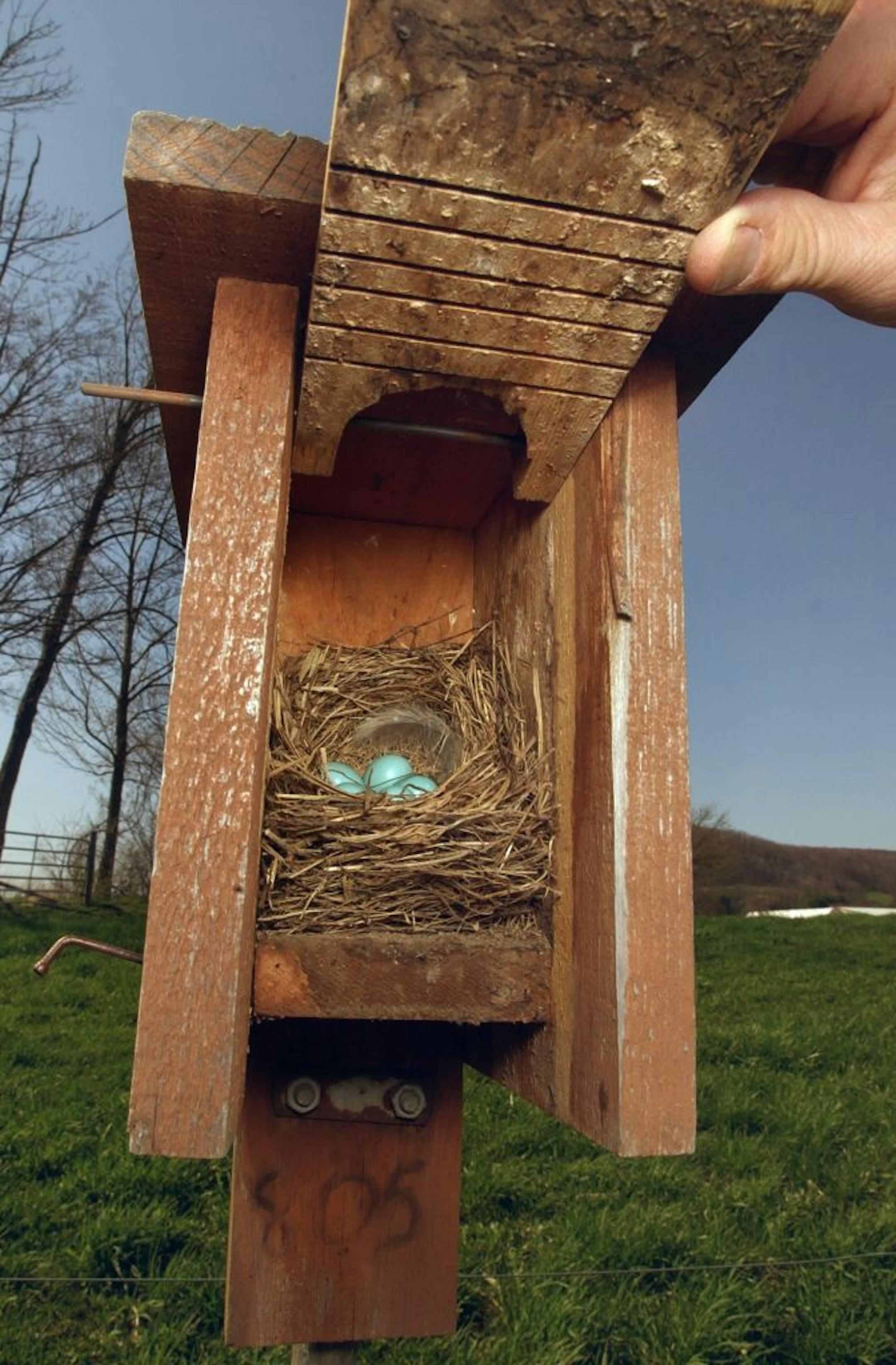
Every five days or so I walk around a nearby golf course, not to play the game but to check on the 15 wooden boxes located around the course -- this series of nest boxes is what's called a bluebird trail. A handy Phillips screwdriver opens each box to reveal the birds inside so I can note if things are OK or whether the occupants are being bothered by predators (house sparrows or raccoons) or pests (wasps or flies).
Tree swallows, chickadees and bluebirds all make use of these birdhouses, and all of them are welcome (however, house sparrows, a nonnative species, aren't), and monitoring them gives me the chance to observe the marvel that is the nesting process. Tiny eggs are deposited, one per day, in the nests inside the boxes until a brood is complete (four to five eggs for bluebirds, for example).
About two weeks later these hatch into minuscule infants that grow, barring accidents, into large, healthy young birds. And then suddenly they're gone, emerging out into their new world. (Unless you're a trained volunteer, please don't open bluebird boxes -- they get used to their monitor's once-a-week visits, but any more would be disruptive.)
It all starts with the egg, that incredibly ingenious solution to the challenges of nurturing embryos outside a mother bird's body. An egg is a complete life-support system, keeping the developing bird safe and well-fed during the incubation period: The yolk feeds the developing chick and the shell protects its valuable contents from the elements. Eggshells even breathe, allowing oxygen to enter and waste gases to leave.
Easter egg colors
My golf course nest boxes hold the bright white eggs of tree swallows, the chickadee's brown-speckled eggs and, prettiest of all, the sky-blue eggs of the bluebirds. The bird world produces great variety in coloration, with hues to rival Easter eggs, including blue, green, deep red, yellow and sometimes white. Some species' eggs feature speckles, streaks, splatters, blotches or other kinds of designs. Bird species that lay pure white eggs are in the minority.
But not all birds nest inside nest boxes or tree cavities; in fact, only about 10 percent of all the world's birds do so. The majority, such as ducks, robins and orioles, raise their youngsters in a nest outside. In the case of a shorebird like the killdeer, a nest is little more than a scrape on the ground among stones or even in parking lots. Killdeer eggs are very blotchy, providing camouflage in most situations.
Cardinal eggs are often a pale green, heavily marked with dark spots. Predators do not easily spot these eggs, sitting in a nest well hidden in a thick shrub. Bobolinks are ground-nesting birds and lay brown eggs that blend in with a field's dried grasses and hay. Blue jay eggs tend to have an olive-colored background with many darker spots and dots.


