

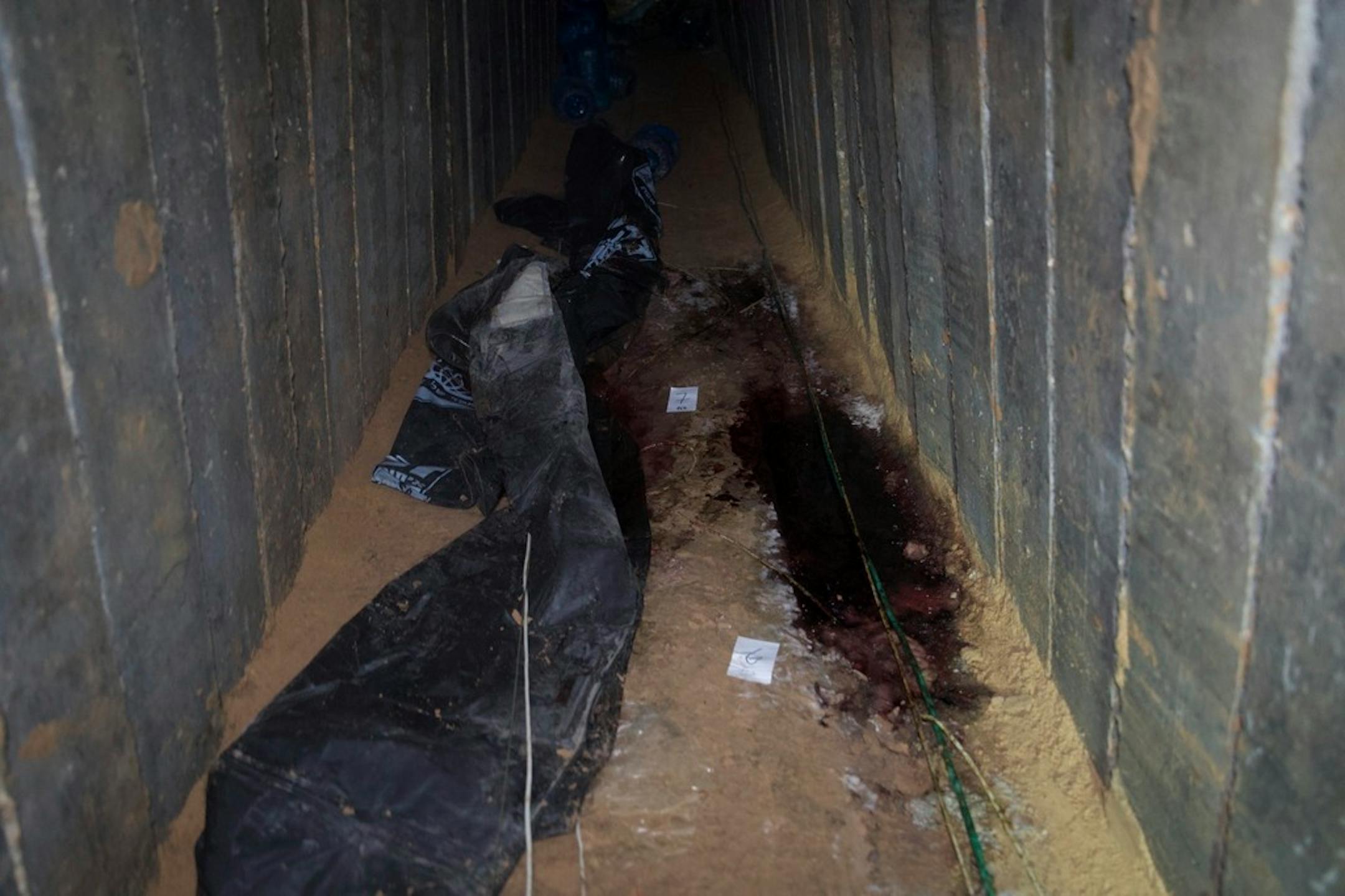
JERUSALEM — The Israeli military on Tuesday released video footage of a Gaza tunnel where it says six hostages were recently killed by Hamas. The video shows a low, narrow passageway deep underground that had no bathroom and poor ventilation.
The discovery of the hostages' bodies last month has sparked a mass outpouring of anger in Israel and the release of the new video could add to the pressure on Prime Minister Benjamin Netanyahu to reach a cease-fire deal with Hamas to bring the remaining hostages held by Hamas home.
Israeli military spokesman Rear Adm. Daniel Hagari said Tuesday the footage of the Gaza tunnel had been shown to the hostages' families, and that it ''was very hard for them to see how their loved ones survived in those conditions.''
Hagari revealed the video in a nationally televised press conference after visiting the tunnel himself. He said the tunnel was reached by a shaft buried under a child's bedroom in a home in the southern Gaza town of Rafah. The tunnel was about 20 meters (70 feet) underground and stretched about 120 meters (yards).
In the video, a hunched-over Hagari, unable to stand upright in the narrow arched passageway, describes the conditions as extremely humid and difficult to breathe. He showed bottles of urine, a bucket that appeared to have served as a makeshift toilet, a chess board and ammunition for an automatic rifle believed to have been used by the captors.
''They were here in this tunnel in horrific conditions, where there's no air to breathe, where you cannot stand," he said.
The six included Israeli-American Hersh Goldberg-Polin, 23, a native of Berkeley, California, whose parents led a high-profile global campaign seeking his release. Goldberg-Polin lost part of his left arm to a grenade in the Oct. 7 attack that sparked the war in Gaza. In April, Hamas issued a video that showed him alive, sparking protests in Israel. The army identified the others as Ori Danino, 25; Eden Yerushalmi, 24; Almog Sarusi, 27; Alexander Lobanov, 33; and Carmel Gat, 40.
Three of the six – including Goldberg-Polin – had reportedly been scheduled to be released in the first phase of a cease-fire proposal discussed in July, further fueling anger when they were found dead.
