

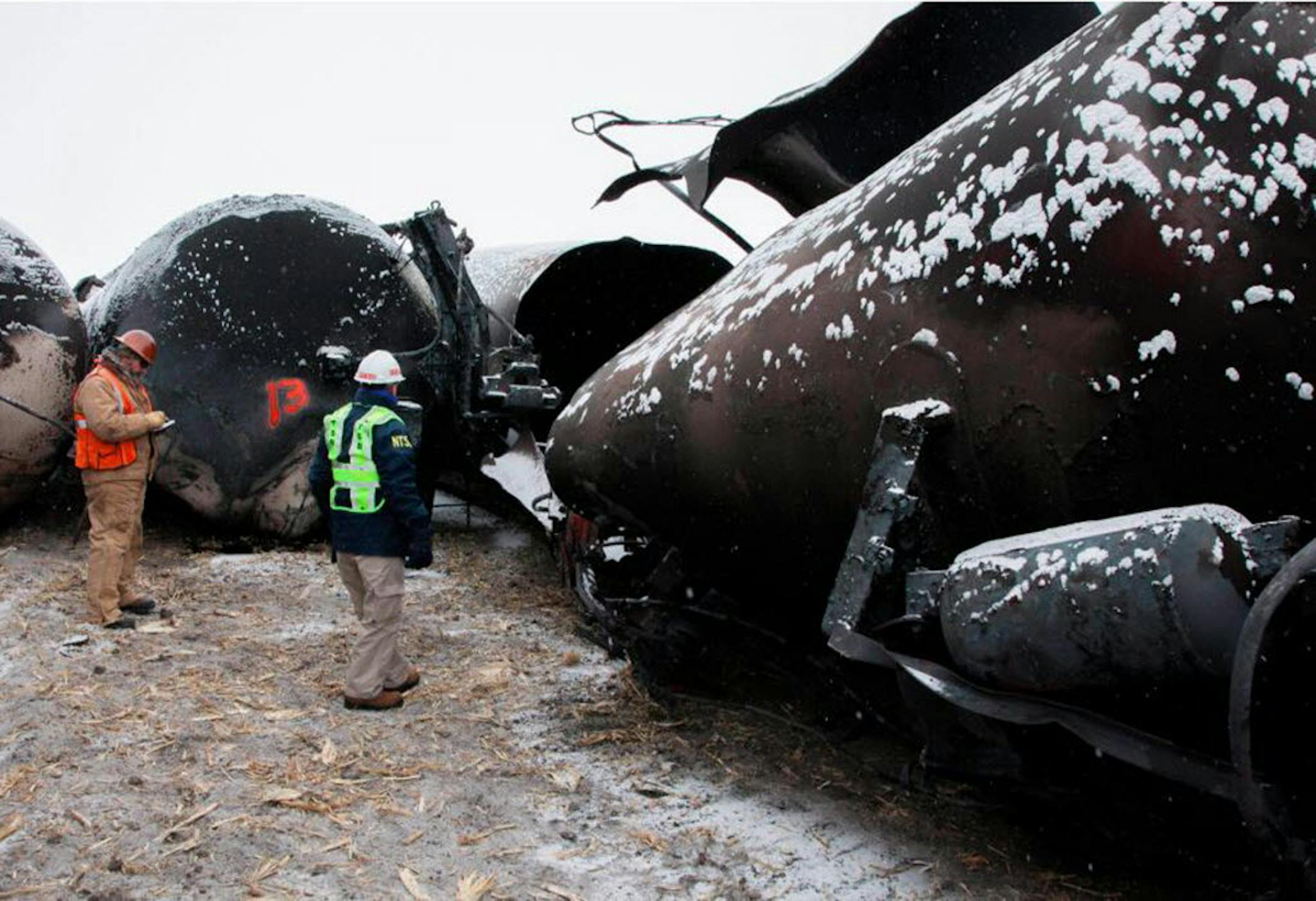
Six trains with 100 or more crude oil tank cars pass through the Twin Cities every day, and if one of them wrecks, state and local emergency responders don't have the equipment needed to put out a catastrophic fire, state and local officials say.
To fight a major oil-train fire, local fire departments would need help from railroad emergency crews, officials said. That was the case in the Dec. 30 derailment, explosion and fire of an oil train near Casselton, N.D. Massive amounts of fire-suppressing foam, rather than standard water hoses, are needed to extinguish raging tank-car fires.
"There isn't a fire department that has that much foam right now," Jim Smith, assistant chief of operations for the St. Paul Fire Department, said in an interview Tuesday. Smith joined other emergency responders to discuss the issue last week with BNSF Railway Co., the largest North Dakota crude oil hauler.
BNSF and Canadian Pacific, the other regional crude oil hauler, have robust firefighting capabilities and have long worked with local fire departments on emergency response efforts. But some Minnesota officials say first responders need their own capability to fight a major crude oil fire involving multiple tank cars in a populated area.
"We are ill-prepared for this," said state Rep. Frank Hornstein, DFL-Minneapolis, who is preparing legislation with Sen. Scott Dibble, DFL-Minneapolis, to address shortcomings in the state's ability to cope with crude-oil emergencies on railroads or pipelines. "This is overwhelming the state right now."
Worries about Minnesota's rail-disaster response have emerged as Congress is studying rail safety after recent accidents, including the July crash of a North Dakota oil train that killed 47 people in Lac-Mégantic, Quebec. On Thursday, the U.S. Senate Commerce Committee's subcommittee on transportation will hold a hearing on rail safety, and a House committee will follow with a hearing later this month.
State is major way point
North Dakota, now the second-largest oil producing state, relies on rail to ship 70 percent of its nearly 1 million barrels per day of crude oil. Much of it gets loaded onto long "unit trains" that go from North Dakota to East Coast or Gulf Coast refineries.
This crude-by-rail business didn't exist five years ago. Now, Minnesota is a major way point for these shipments. On average, eight oil trains of about 110 cars each pass through Minnesota daily, with six of them going through Minneapolis and St. Paul, said Dave Christianson, who oversees freight and rail planning for the Minnesota Transportation Department. All of the trains, including about two a day that go south through western Minnesota, pass through many smaller towns, he said.


