

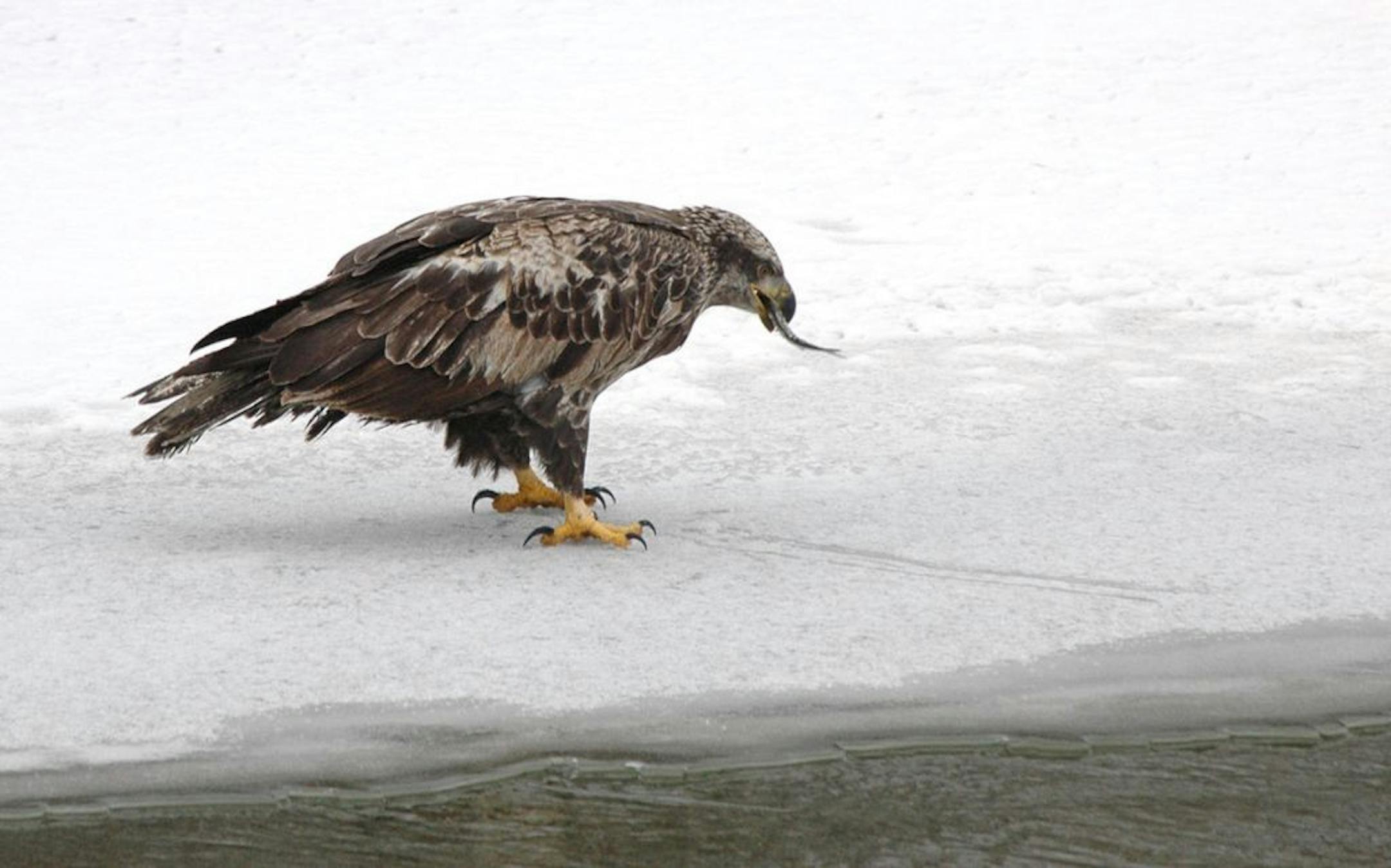
Q We're having house guests over the holidays and I know they'll want to see bald eagles. Is that possible and, if so, where can we find some eagles?
A Yes, it's possible to see bald eagles right here in the metro area all winter, as long as there's open water nearby.
But I'll bet your guests will be more excited by the eagle viewing in Wabasha, Minn. The river stays open there year-round and eagles often stack up in the shoreline trees. And your guests will be fascinated by the exhibits and live, educational eagles inside the National Eagle Center (www.nationaleaglecenter.org) in Wabasha, as well.
Nuthatch caches Q A nuthatch takes peanut pieces out of our feeder, then flies off to bury them in the leaf litter around my neighbor's foundation. This doesn't seem like a safe hiding place, so I wonder why it's doing that.
A Nuthatches are one of the birds that hide food for later consumption, as you observed. There aren't very many safe places to store food out in nature, since there's always the chance that some other creature -- another bird, a squirrel, maybe a mouse -- will happen along and find it. So the nuthatch is using a "scatter hoarding" technique, hiding away food in a variety of locations, in the hopes that some will escape a scavenger's eye.
Ailing goose Q We live in a rural area and recently we had a Canada goose sitting outside, without moving, for about 36 hours. But when I brought out a dish of water, the goose flew away. We wonder what was wrong with it, and my husband wonders if it could have been due to lead poisoning or a predator.
A We'll probably never know what was wrong with the goose, but you were kind to offer it some water. There are many possible causes for lethargy in a wild bird, and your husband is right, lead poisoning might be one possibility.
However, the fact that the bird could gather enough energy to fly away argues for some other cause. It's possible that the bird had a bacterial illness and needed a couple of days to rebuild its strength, or it may have lacked the energy to withstand the sudden cold, and found a brief respite in your yard. If the goose had been attacked by a predator, you almost certainly would have seen signs of it, such as scattered feathers.


