

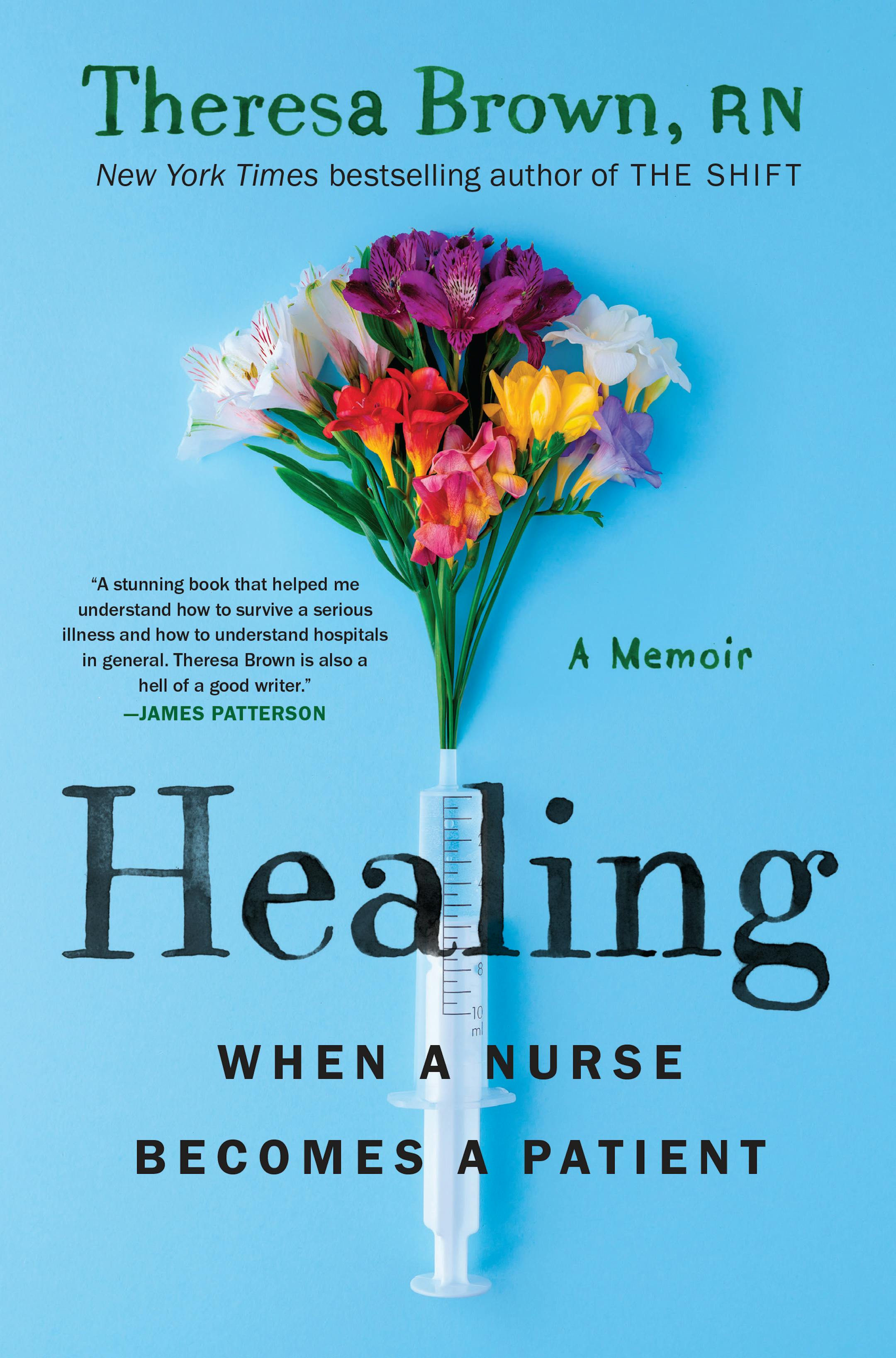
On the day Theresa Brown received a preliminary breast cancer diagnosis at a Pittsburgh hospital, she learned that a biopsy was needed to confirm the news and that it would be arranged before she left the premises that day. In shock and leaking tears, Brown made her way to the scheduling desk. Before long a receptionist told her that she had "just missed" the scheduler, whose shift ended at 3. In fact, it was just then 3 o'clock precisely; the scheduler had departed early.
"I wanted to slam the receptionist into the wall," Brown writes. "I wanted to punch her in the stomach and as she doubled over, gasping for breath, smash my fist into the bridge of her nose. I wanted to hear bone crack."
This incandescent anger fuels Brown's memoir, "Healing: When a Nurse Becomes a Patient." Brown offers no gushing gratitude for her care team, nor thankfulness for a chance at personal growth stemming from a life-threatening illness; she wants no part of the "cancer is a gift" approach. What she does offer lifts "Healing" above the usual fare in the ever-expanding genre of illness memoir: an unflinching look by a former nurse at the lack of compassion in our health care system and the harms that patients suffer because of it. A longtime contributor to the New York Times on health care issues, Brown writes with a winning combination of passion, humor and medical knowledge.
She describes compassion in health care as "effective communication, emotional support, trust and respect, mutual decision-making, and treating patients as people, not just illnesses." This is exactly what her care lacked: "My treatment took place at a so-called cancer center, but no one there did anything to manage my fear or calm my soul by explaining the process. ... No one — except for the ultrasound tech — told me, 'We can treat this.' "
In fact, Brown's breast cancer, a variety of ductal carcinoma in situ, or DCIS, was invasive (found outside the milk duct) but very much treatable. It was of the type ER+/PR+, positive for the hormones estrogen and progesterone, and HER2-, negative for human epidermal growth factor receptor 2. Brown writes with keen awareness that, at least in the dark hierarchies of Cancerworld, she was comparatively lucky.
Yet she describes delays and dysfunction that repeatedly made a stressful experience more stressful. Originally, only radiation was planned, but then chemotherapy was considered as an option; if needed, it would precede radiation. She had an appointment with a medical oncologist six weeks out and could find nothing sooner. Here was "a classic catch-22": The delay meant she couldn't know quickly if chemo was necessary, and she couldn't begin radiation until she knew whether chemo was necessary.
Desperate, Brown called on her connections from her previous work as a nurse, first in oncology and later in hospice. She saw the doctor that next week (and was told the timing change had nothing to do with her medical connections but instead with a call from her husband). Within five minutes, through the use of an equation on a computer, the doctor announced that no chemo was required.
Delays really rattle Brown. Post-treatment, she had a mammogram on the Wednesday before the Labor Day weekend. That Friday morning, she e-mailed the scan coordinator saying she expected to receive the results that day. A reply came that radiologists were reading her scan, but the day wore on and no results arrived. Brown exploded: "Do your damn job," she e-mailed, then took to Twitter to complain.


