

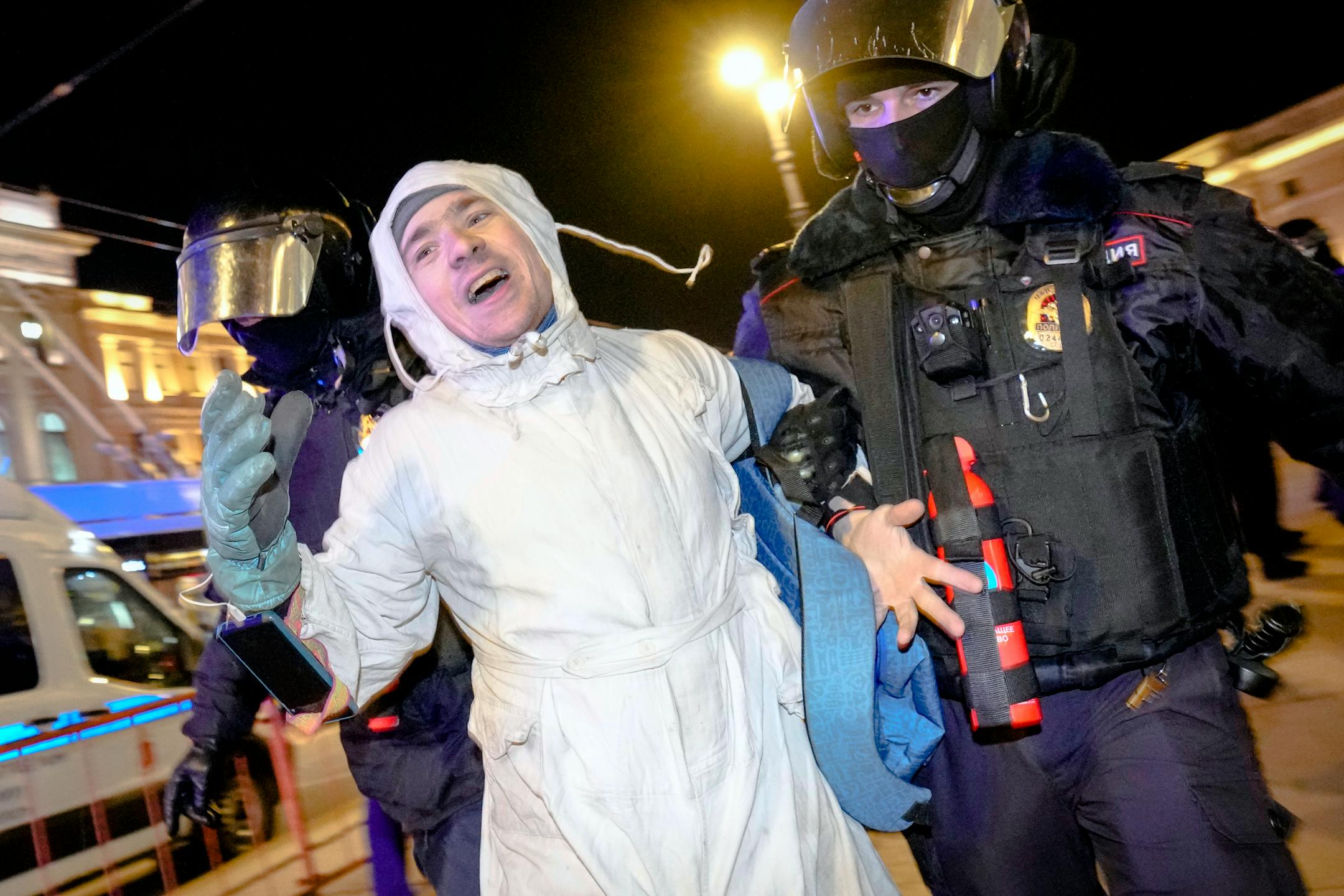
NEW YORK — Russian authorities on Sunday continued to block independent news outlets and to arrest protesters in an effort to tighten control over what information the domestic audience sees about the invasion of Ukraine.
Multiple independent online outlets were blocked on Sunday, on top of dozens of others that were blocked last week. Others decided to halt their operations in Russia because of new repressive laws or refused to cover the invasion at all because of the pressure. Hundreds of protesters have been detained across Russia.
The new additions to the list of blocked media included Mediazona, a news site that covers Russia's police and justice system and has been an indispensable source of information about political arrests and high-profile court cases; the website of Snob magazine; the Agentstvo investigative news outlet; the 7x7 site covering regional news; the Troitsky Variant popular science newspaper that has published an open letter decrying the invasion; and two regional news sites that also spoke out against the attack.
U.S.-funded broadcaster Radio Free Europe/Radio Liberty announced Sunday it was suspending its operation in Russia after it said the country intensified pressure on its journalists and tax authorities initiated bankruptcy proceedings against it.
"(Russian communications and media agency) Roskomnadzor demanded we delete our entire website. Yes, we received this demand from the agency — to block ourselves. Because we incorrectly cover Russia's attack on Ukraine and call the war a war," Mediazona said in a statement.
"We were prepared for this. In recent days, military censorship has been effectively introduced in Russia, and there are almost no independent media left in the country. We understand all our risks, but we continue to work — this is our duty to our readers and to ourselves," the outlet said and listed several ways Russian readers can get around the block.
RFE/RL, which has been physically present in Russia since 1991, was planning to continue reporting on Russia and its war in Ukraine from abroad.
"We will continue to expand our reporting for Russian audiences and will use every platform possible to reach them at a time when they need our journalism more than ever," chief executive Jamie Fly said.


![Attendees of Frostbike made their way through the convention Saturday at the Quality Bike Products campus in Minneapolis. ] (AARON LAVINSKY/STAR TRIBUNE) aaron.lavinsky@startribune.com Frostbike 2016 was held at the Quality Bike Products Campus on Saturday, Feb. 27, 2016 in Bloomington, Minn.](https://arc.stimg.co/startribunemedia/NH2BSHB74ND2V6GF2G2HI5X4MM.jpg?&w=252&ar=3:2&fit=crop)
