
Vaccines and CDC chaos expose tensions between Trump and Kennedy

While there is no evidence of a break between them, Health Secretary Robert F. Kennedy Jr. has caused consternation among President Trump and some of his aides.

The New York Times
September 13, 2025 at 6:37PM
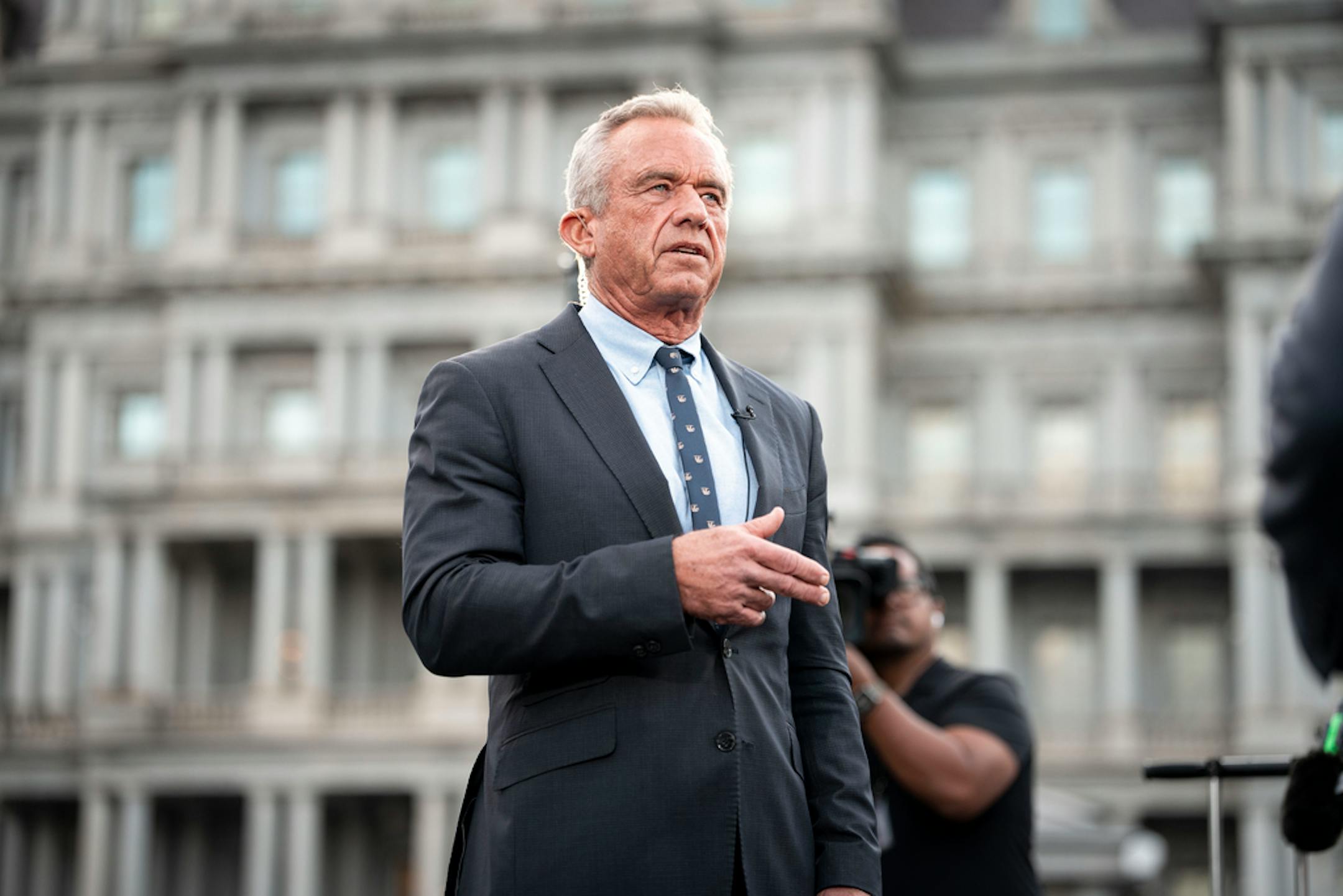
Secretary of Health and Human Services, Robert F. Kennedy Jr., outside of the White House in Washington, Tuesday, Sept, 9, 2025. (DOUG MILLS/The New York Times)

WASHINGTON — Health Secretary Robert F. Kennedy Jr. faced a tricky moment Tuesday when he released a report outlining President Donald Trump’s “Make America Healthy Again” strategy.

Asked by a reporter if he agreed with Trump’s comment that some vaccines work, “pure and simple,” Kennedy, a famous vaccine skeptic, at first ducked the question. “I agree with that,” Kennedy finally said. Trump’s top domestic policy adviser, who presided over the event, banged his gavel, bringing questions to a close.

The awkward scene capped a particularly fraught two weeks for the president and his celebrity health secretary. While there is no evidence that Trump is going to break with Kennedy, the secretary has lately caused consternation among some of the president’s aides and the president himself for a series of negative headlines about chaos inside the Centers for Disease Control and Prevention, and about his views on vaccines.

The White House projected itself as unbothered when Kennedy pushed out Susan Monarez, the CDC director, just one month after the Senate confirmed her. But two people briefed on what took place said Trump — who declared Monarez “an incredible mother and dedicated public servant” when he nominated her — was irritated by the situation and all the negative coverage.

Kennedy’s sharp criticism of COVID-19 vaccines has also been a sticking point. In recent days, White House officials — though not Trump directly — sent Kennedy and his advisers a message telling him to tone down his rhetoric, according to two people briefed on the discussions.

That is partly because of concerns the White House has heard from some allies about Kennedy’s comments, as well as Trump’s own pride in Operation Warp Speed, the initiative that produced the shots in his first term.

The events of the past two weeks — Kennedy’s ouster of Monarez, followed by the resignation of three high-level CDC officials and a fiery Senate hearing where Republicans challenged Kennedy’s stance on vaccines — have put a spotlight on the complexities and tensions in one of Washington’s most eclectic and closely watched partnerships.

Kennedy, the nephew of President John F. Kennedy and son of a senator, occupies a unique place in Trump’s Cabinet — and in Republican politics. He has a big name and a big following. No other member of the administration, beyond the president himself, cuts a higher profile. Trump is enamored of the Kennedy name and likes Kennedy personally, and he has given the health secretary unusually wide latitude to pursue his agenda.

But Kennedy clearly knows his place. Despite his criticism of the COVID shots, he testified on Capitol Hill last week that Trump deserved a Nobel Prize for Operation Warp Speed.

On Tuesday, he heaped praise on the president while presiding over the release of the second MAHA Commission report, which outlines a strategy for combating chronic disease among children, a phenomenon Kennedy called an “existential crisis” for the country.

“I’m so grateful I work for a president that is willing to run through walls to stop this and to heal our kids,” he said. Although he and Trump have so far been unwilling to use regulation or legislation to rein in industry, Kennedy called the president “fearless about challenging entrenched interests.”

Spokespeople for both Trump and Kennedy rejected the idea that there are tensions between the two.

Kush Desai, Trump’s spokesperson, said the White House “maintains full confidence” in Kennedy. Andrew Nixon, Kennedy’s spokesperson, said the health secretary “speaks regularly with White House officials,” and that he and Trump “are united in their commitment to make America healthy again.”

Last week’s Senate hearing signaled a potential weakening of support for the health secretary among some Republicans on Capitol Hill. Trump neither defended Kennedy nor embraced him, and has issued seemingly conflicting statements about vaccines.

Questioning a move by Florida to end its childhood vaccine mandates, the president said vaccines work, “pure and simple.” But he also posted a video on social media promoting the idea that vaccines are linked to autism — a theory he has espoused for nearly two decades despite scientific evidence to the contrary.

The video focused on a mercury-based preservative that has been removed from nearly all childhood vaccines. It featured David Geier, who has been hired by Kennedy to work on a study on the causes of autism that is expected this month.

On Sunday, the president suggested that he viewed Kennedy as an unconventional thinker — who may be too unconventional at times.

“He’s a different kind of a guy,” Trump said. “He’s got a lot of good ideas — but he’s got a lot of ideas.”

Like Kennedy, Trump appears to have been influenced by a 1998 study, published in the medical journal the Lancet, asserting that the measles, mumps and rubella vaccine was linked to autism. The study was eventually retracted, though not until 2010, and its lead author, Andrew Wakefield, lost his medical license.

In 2007, Trump held a fundraiser for Autism Speaks, a parent advocacy group, at Trump’s Mar-a-Lago resort in Florida. He theorized that babies were getting too many shots at once, and said that he and his wife, Melania, had slowed down the vaccine schedule for their son Barron, then almost 2.

“What we’ve done with Barron, we’ve taken him on a very slow process,” Trump said then. “He gets one shot at a time, then we wait a few months and give him another shot, the old-fashioned way.”

Trump’s stance seemed to have brought Kennedy into his orbit. In January 2017, 10 days before Trump was inaugurated as president, Kennedy visited him at Trump Tower in New York. Speaking to reporters in the lobby of the building after the meeting, he said Trump had been “very thoughtful” and had asked him to chair a commission on vaccine safety and scientific integrity.

“President-elect Trump has some doubts about the current vaccine policies, and he has questions about it,” Kennedy said at the time.

But Trump’s team quickly put the kibosh on the idea, saying that while Trump was concerned about autism, the commission was not going to happen. Kennedy chose not to pick a fight with the new president.

Not quite eight years later, in 2024, when Kennedy was running for president as an independent, one of his advisers, Calley Means, sensed an opening for the two to connect. When Trump survived an assassin’s bullet at a campaign event in Butler, Pennsylvania, Means urged Kennedy, whose own campaign was flailing — and who had experienced the trauma of political assassinations in his own family — to call Trump.

Kennedy’s eventual endorsement gave Trump a major media event that helped amplify press coverage roughly a month after Democrats had swapped candidates from President Joe Biden to Vice President Kamala Harris. At Tuesday’s MAHA report event, Vince Haley, the domestic policy adviser who gaveled the session to a close, called it an “electrifying moment.”

At the time, people in both parties were stunned to see Kennedy, the nation’s leading vaccine skeptic and a scion of a Democratic dynasty, turn his back on his family to support a man Democrats despised. But even beyond their shared concerns about autism, Kennedy and Trump are not as different as they may seem.

Both relish their roles as outsiders who are shaking things up. Both are profoundly suspicious of academia and the federal bureaucracy. Trump decries the “deep state,” and Kennedy continually calls the agencies he oversees “corrupt.”

There is no unanimity of opinion within the president’s world on whether Kennedy’s voters helped put Trump over the top in the general election, or whether there was already major overlap between the Kennedy base and the Trump base. Some Kennedy voters cast their ballots for Kennedy in states where they could.

But their relationship is mutually beneficial. Kennedy supporters are clearly important to the Trump coalition. At the same time, Trump, who has demonstrated a knack for marketing and brands, has latched onto the MAHA slogan, effectively co-opting a term invented last year by Kennedy. The president has also given Kennedy something he has never had: the authority to make policy.

“For 20 years, I’ve gotten up every morning on my knees and prayed that God would put me in a position where I could end the childhood chronic disease epidemic in this country,” Kennedy said in February at his swearing in. “On August 23rd of last year, God sent me President Trump.”

People close to both men say the relationship is more than merely transactional. “I think that there’s genuine respect and affection,” said Charles Eisenstein, Kennedy’s former speechwriter.

Vani Hari, a healthy eating activist who attended a May White House event where Kennedy and Trump released the first MAHA report, said she sensed “a connection” between the two men. She recalled the president’s words: “MAHA is hot, and it’s really hot.”

But while Kennedy’s healthy eating agenda and his efforts to curb chronic disease are popular in both parties, his stance on vaccines is divisive, including among Republicans, and could be problematic for the president.

Polls show broad support for childhood vaccines, but less support for COVID vaccines. In the run-up to last week’s Senate hearing, a memo from Republican pollsters Tony Fabrizio and Bob Ward warned Republicans that it “would be folly” for them to mistake skepticism of COVID shots for opposition to all vaccines. It noted “sky-high” approval for routine vaccinations among swing voters.

The report Kennedy issued Tuesday was initially expected in August; at the time, a person familiar with its planning suggested the release was being delayed so Trump could participate in the rollout.

Trump was not there Tuesday, and White House officials cited scheduling conflicts. Kennedy announced during the event that he would be seeing the president later in the Oval Office, where Trump signed a memorandum directing the health secretary to take steps to “ensure transparency and accuracy” in drug company advertisements to consumers.

Trump, running behind schedule, put his signature on the document behind closed doors, and the two men were not seen together. When the signing was over, Kennedy walked out of the West Wing to do an interview with his preferred television network, Fox News.

about the writer

about the writer

Sheryl Gay Stolberg and Maggie Haberman

More from Politics

See More
card image
Renée Jones Schneider/The Minnesota Star Tribune

Minnesota Attorney General Keith Ellison, along with the cities of Minneapolis and St. Paul, sued the federal government in an attempt to end ICE’s Operation Metro Surge.

card image