

ANDYKOZHAR BATYR,
KAZAKHSTAN
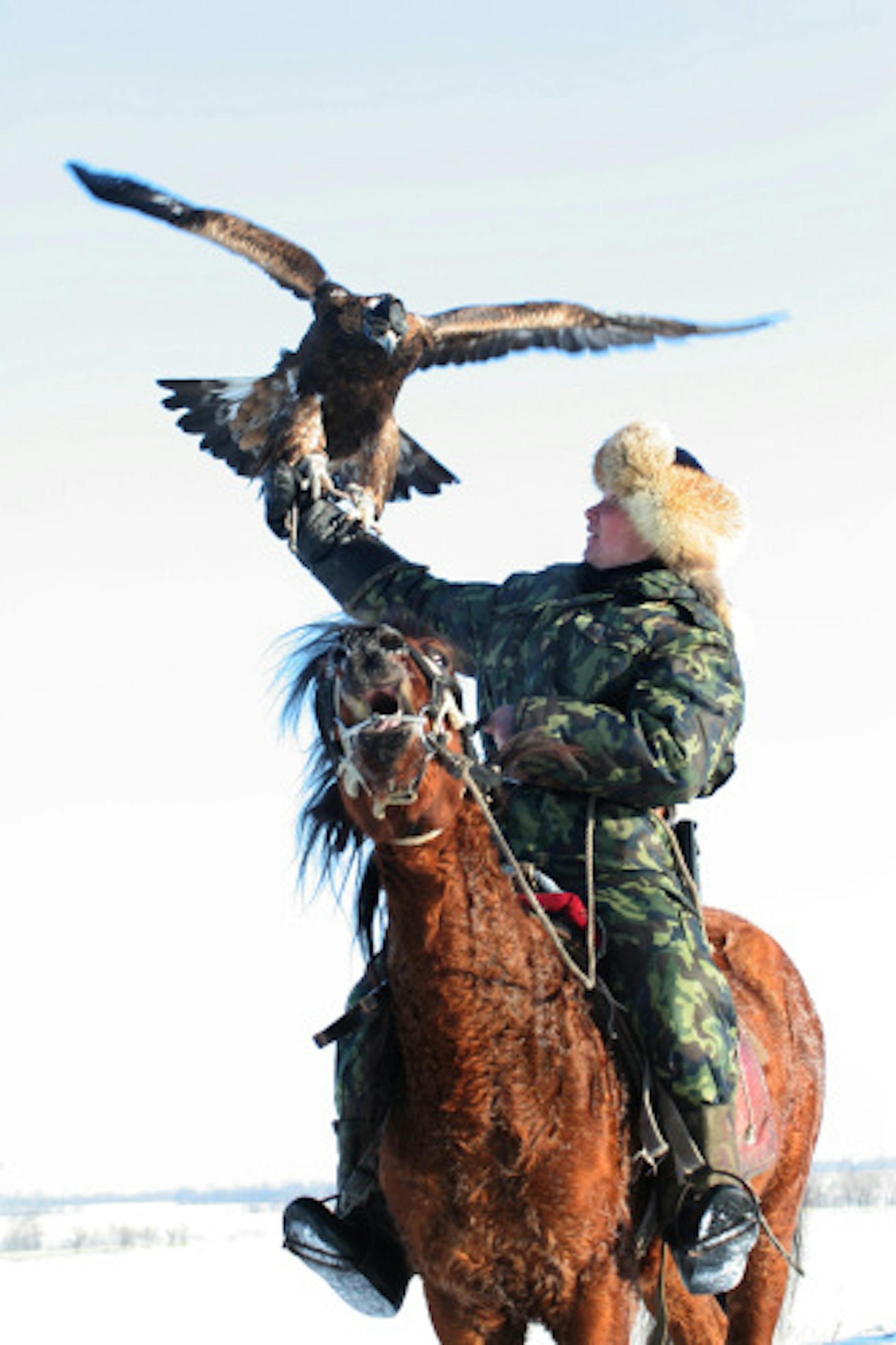
Under a cloudless sky on the Kazakh steppe, a hare scampers over the snow-dusted scrub, about two football fields from a young hunter in camouflage and the golden eagle he supports on a black gauntlet.
The hunter gently pulls off the eagle's hood. The bird's gaze swivels from one end of the horizon to the other, stopping momentarily to spy the hare. With a shout, "Hah!" he releases the eagle. It ascends with two flaps of its 5-foot wingspan, then swoops downward in a blink-of-an-eye glide that ends with the bird's 3-inch talons clutching the rabbit's head.
Later, at the top of a lone hill, the hunter, Ablykhan Zbasov, explains what tethers him to a sport practiced by his forefathers more than 3,000 years ago, a casualty of the Soviet era now gradually making its way back to the Kazakh plains.
"When you hunt with a rifle, this is not interesting," says Zbasov, 30. "But when you have the bird and your horse with you, you feel united with nature. It's really beautiful. You never forget the bird's grasp of your wrist, how powerful it is."
Zbasov and the rest of Kazakhstan's small but avid falconry community want their countrymen to know that feeling. At a time when an oil boom is endowing Kazakhstan with skyscrapers, SUVs and a budding middle class, Kazakh falconers are trying to revive their sport's stature as a pillar of national identity.
Through seven decades of Soviet rule, Kazakhstan's love affair with falconry flickered as expressions of ethnic identity were suppressed, but it never died out. Today in southeastern Kazakhstan, Kazakhs from other regions of the Central Asian nation have begun signing up for falconry courses at the Zhalair Shora Falconry Center and Museum in Nura, a small village at the foot of the Tien Shan Mountains.


