

A June United Nations report on the record exodus across countries and continents chronicled a migration crisis so vast that one out of 122 people in the world is now a refugee, an internally displaced person or an asylum-seeker. That staggering figure equates to the world's 24th-most populous country. Tragically, half are children.
Reflecting on the report in my June 20 column, "World Refugee Day — and Decade," I observed that despite the enduring crisis there had not been a media moment that had grabbed global attention or reframed the debate the way that "Migrant Mother," Dorothea Lange's iconic Depression-era photo, captured the individual humanity behind mass migration.
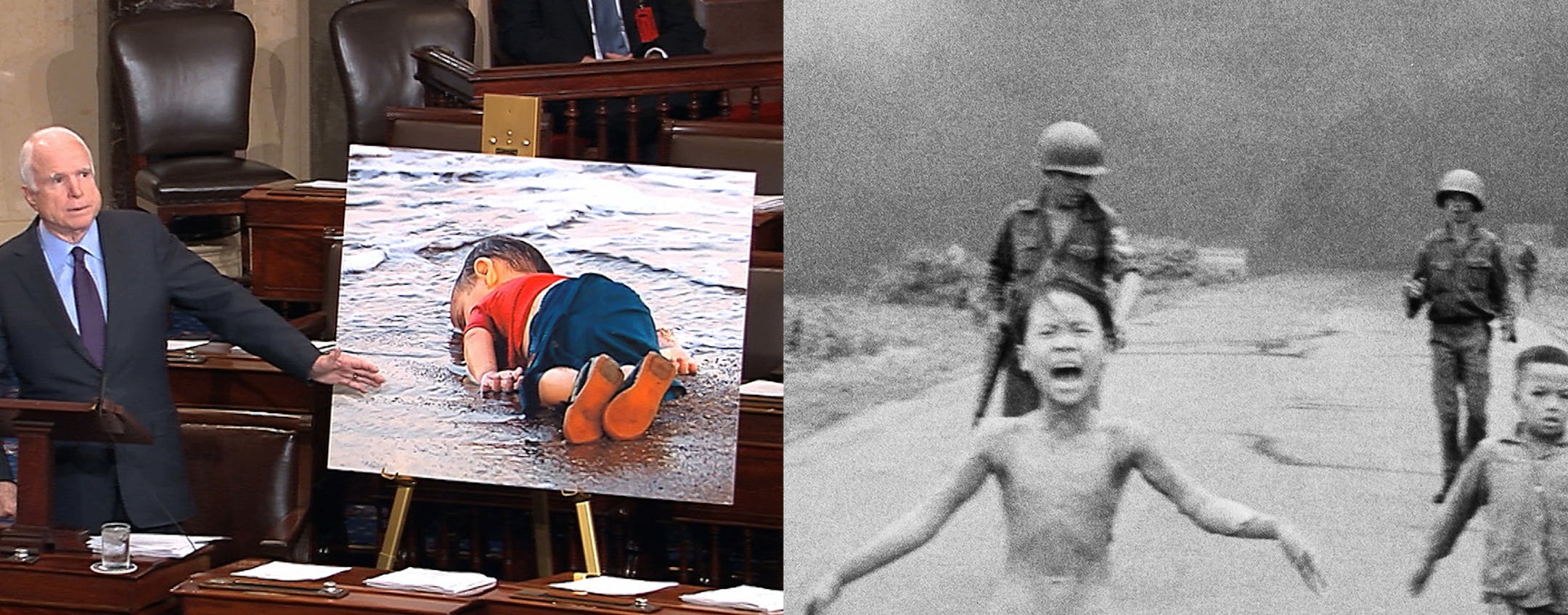
That changed last week, when the heartbreaking photos of Aylan Kurdi, the 3-year-old Syrian boy drowned on a Turkish beach, rocketed around social media and news websites and then on front pages of newspapers worldwide. Suddenly, finally, the whole world was talking about the deplorable plight of refugees, asylum-seekers and economic migrants.
It was not the first time that a still image moved people. And it was not the first time that a photo of a child imperiled by war-torn or famine-stricken conditions has been globally galvanizing.
Among many notable examples are four Pulitzer Prize-winning photos. In 1972, a naked, napalmed 9-year-old Vietnamese girl, running alongside other terrified children, spoke to the particular horror of that war. In 1985, the gaunt, haunted looks of a starving mother and child at an Ethiopian refugee camp pointed out how political and agricultural failures can claim lives. A year earlier, another photo of another starving Ethiopian child also won a Pulitzer. And a decade later, the grisly image of a vulture stalking a starving Sudanese girl gave witness to that famine.
"With photography, you have a visceral reaction," said Deb Pastner, the Star Tribune's director of photo/video. "As important as the written word is in explaining subtleties and nuance and history, photography can synthesize things into something that anybody can respond to across cultures, across language, across gender, across socioeconomic standing."
That was clearly the case with the photos of young Aylan. People, and parliaments, shamed over the shabby treatment of migrants moved to act, however inconsistently.
The images were shocking. But the tragedy, unfortunately, unsurprising. Scores seeking a better life in Europe have drowned because of high seas and the low value smugglers put on their lives. The migrant crisis is the story of the year, if not an era, and individual depictions of desperate and, sadly, dead migrants have been broadcast or published. And ample evidence of the horrors of the homicidal Assad regime, whose indiscriminate killing has included children, has documented the Syrian epicenter of the exodus.


