

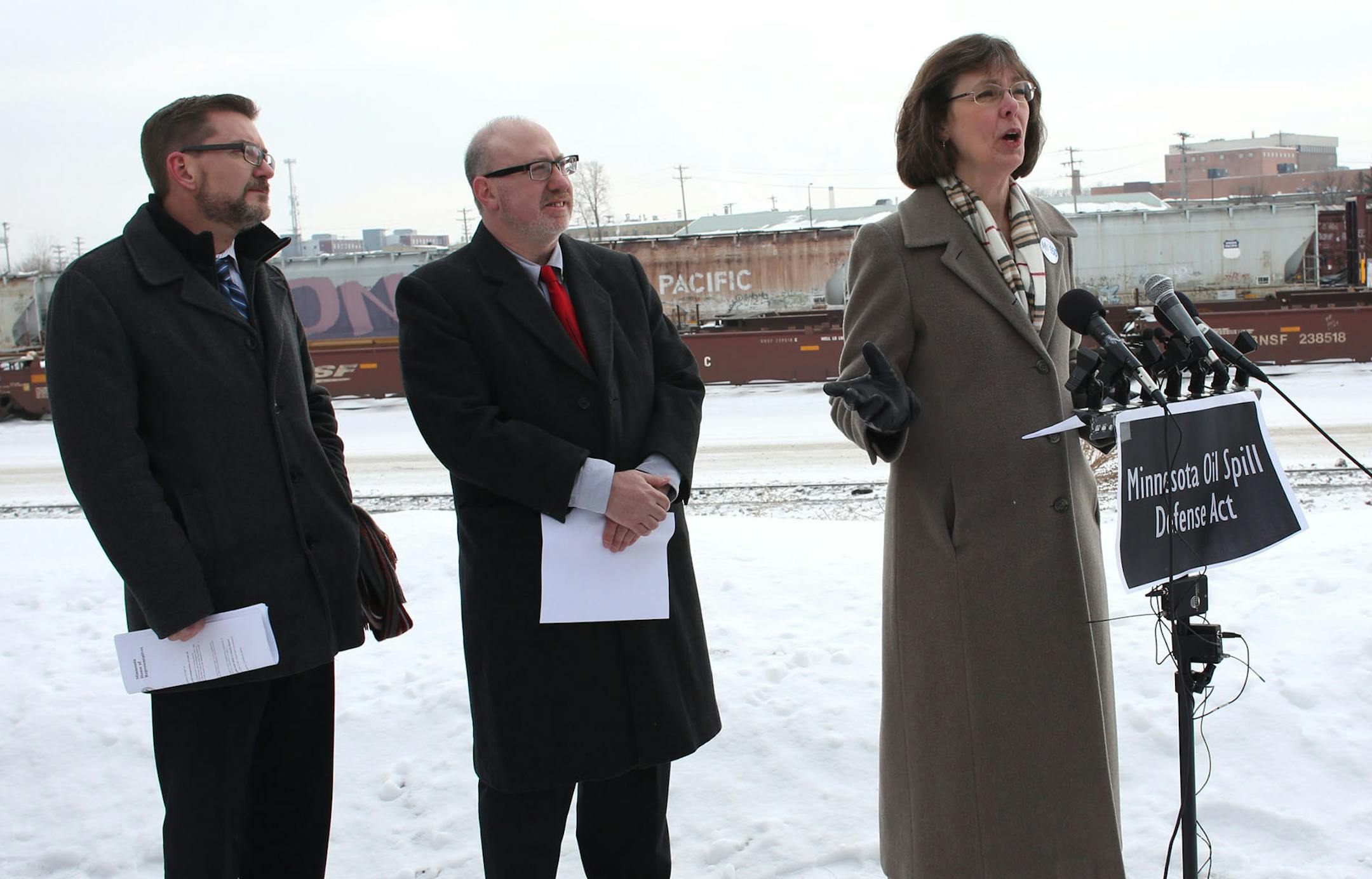
Minnesota legislative leaders Wednesday proposed beefing up the state's capacity to respond to crude oil accidents — and to make railroads and pipeline companies pay for it.
But the sponsors of the "Minnesota Oil Spill Defense Act" said they don't know how much it would cost to train and equip emergency responders to fight catastrophic crude oil fires, such as the derailment and fiery explosion of an oil train Dec. 30 near Casselton, N.D.
Standing along a rail line used by oil trains, two DFL legislators from Minneapolis — Rep. Frank Hornstein and Sen. Scott Dibble — said the state needs to help urban and rural fire fighters to upgrade their emergency preparedness for crude oil spills and disasters.
"Because of the oil booms in North Dakota and Alberta, we are experiencing a tremendous increase in oil transportation traffic by rail, pipelines and there is even a proposal to haul oil on ocean-bound tankers on Lake Superior," Hornstein said at the outdoor news conference.
The legislators, who chair House and Senate transportation committees, are proposing a fee — perhaps 1/100th of a cent — on every gallon of oil that flows through the state by rail or pipeline. That would affect Enbridge Energy, whose pipelines carry crude oil across northern Minnesota, and BNSF Railway Co. and Canadian Pacific, whose rail lines carry about eight unit trains of crude oil through the state daily.
The tens of millions of dollars raised by such a fee annually would fund such things as equipment to deliver massive amounts of foam to burning oil tankers, and an array of other emergency planning and training measures, said Hornstein, who described the state's current capability as "woefully inadequate."
Chris Parsons, a St. Paul fire captain and president of the Minnesota Professional Fire Fighters, said the organization strongly supports the proposed legislation. He said crude oil shipping accidents like the one in Casselton are sure to happen again.
"It is just a matter of time before it occurs in a heavily populated area," Parsons said in an interview.



