

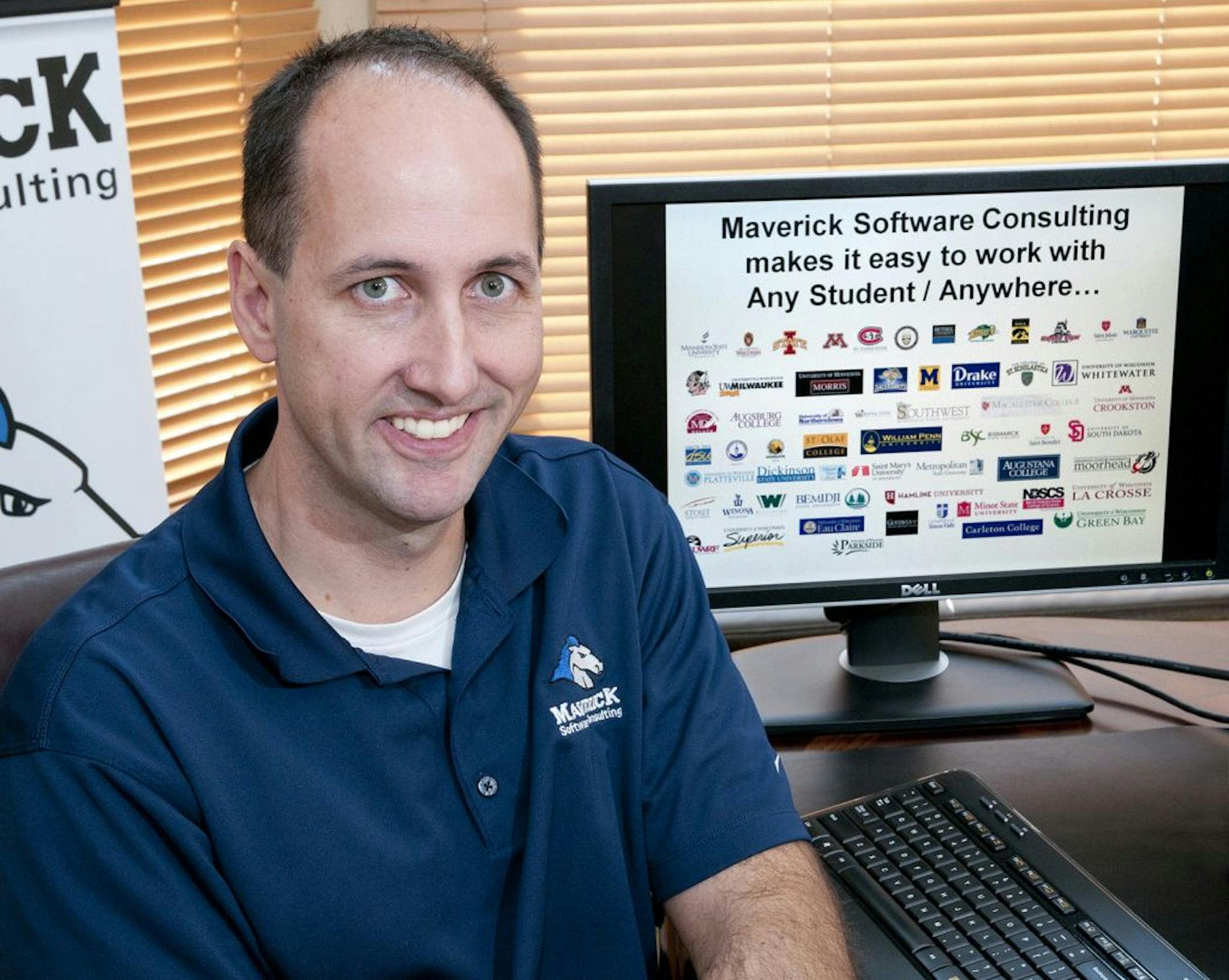
If companies can send jobs offshore, why not send them to Mankato? That's the simple logic that led Marty Hebig to expand his company, Maverick Software Consulting, from one person to 130.
Maverick's consultants are undergraduates majoring in information technology. They work part-time, mostly at their college campus, on projects defined by the client, supervised by experienced team leads.
Hebig first encountered the concept when he was a student at Minnesota State University Mankato. IBM had a partnership with the college, testing their OS400 operating system. When that project shut down, "it just bugged me," Hebig said. "It stayed with me night and day." He worked with the university to restart the project and found a client -- Thomson Reuters -- who agreed to take 10 students. Hebig's partner, Chuck Sherwood, "works everyday with the students." Hebig took over the back end -- invoices, health and dental insurance -- while continuing to work full-time as a testing consultant.
Six years later, Maverick Software Consulting has six clients and 130 student consultants at 25 universities, including every four-year college in Minnesota that has a computer science degree, as well as the University of Wisconsin-Madison and Iowa State University.
Although the low hourly rate was the initial appeal, Hebig says the value to clients now is "a pipeline of new college grads that they've had a chance to work with. They don't have to spent time training that person in." Maverick claims a 100 percent placement rate. "Even in 2008, 2009, 2010, when the economy was really rough, we were still getting students placed. Now they're getting offers in their final semester of school, and some have multiple offers before they graduate."
With Minnesota's four-year schools covered, Hebig says, "Our plans are to expand to every four-year university in Wisconsin, North Dakota, South Dakota and Iowa next year. There really is no limit to how big this could get."
Why is there a shortage of young people going into IT?
After the dot-com bubble burst, people got laid off, and offshoring picked up steam -- it kind of tarnished the reputation. Before, IT had very glamorous appeal. It was a cool job. Also, people think it's hard -- it really isn't. Enrollment dipped in 2008, but it's coming back up to 2000 levels.


